

Christian Living – Humility, Confidence and Pride
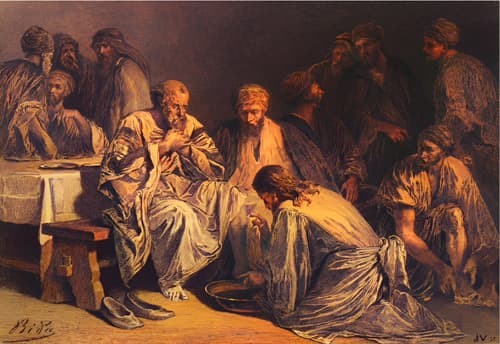
Table of Contents
He has shown you, O man, what is good; and what does the Lord require of you, but to do justly, and to love mercy, and to walk humbly with your God?
– Micah 6.8
Overview
Humility is a primary attribute of the pious and holy people of God. This is an attribute that God requires of His people as we see in Micah 6.8, an attribute that Jesus displayed for us (Phil 2.7), and that the Holy Spirit helps us perform or act in accordance within (Gal 5.22). It is an acknowledgment and an attitude that you are not the greatest, but looking to Christ and acknowledging that God is the greatest whom you can do nothing without, and a personal choice to be the least, a taking on of oneself a lowly position before others to serve a need (requirement).
Humility is a divine characteristic, as it is one of the attributes of the nature of Christ. The Bible teaches believers are to be humble in their walk with Christ.
Definitions & Etymology
Humble in the Old Testament
The words used for humble in Hebrew in the Old Testaments where as follows:
H3665 – kana – properly to bend the knee, to humiliate, vanquish, bring down low into subjection, humble (self) subdue. (36 occurrences in the KJV)
H6031 – anah – to depress lit. or fig. abase self, afflict (self), chasten self, deal hardly with, exercise, force, gentleness, humble, hurt, ravish, submit self, weaken. (83 occurrences in KJV)
H8217 – shaphal – depressed, lit. or fig. base, humble, low. (18 occurrences in KJV)
Humble in the New Testament
The words used for humble in Greek in the New Testaments where as follows:
G5013 – tapeinoo – to depress, fig. to humiliate (in condition or heart), abase, bring low, humble self. (14 occurrences in the KJV)
Pride in the Old Testament
The words used for priode in Hebrew in the Old Testaments where as follows:
H1347 – gaon – arrogance, excellency, majesty, pomp, pride haughtiness, highness, proudly, swelling (49 occurrences n the KJV)
H2087 – zadon – arrogance, presumptuously, proud, proud (11 occurrences in the KJV)
Pride in the New Testament
The words used for pride in Greek in the New Testaments where as follows:
G212 – alazoneia – self-confidence, boasting, pride (1 John 2.16)
G5187 – tuphoo – envelop with smoke, inflate with self conceit, high minded, lifted up with pride, be proud. (1 Tim 3.6)
G5243 – huperephania – haughtiness, pride (Mark 7.22)
Humility of Christ
Our Lord Jesus teaches us to be humble as He is humble, and throughout the New Testament Christians are instructed to live humble lives, abasing themselves and considering the needs of others. Jesus teaches us that He is the meek and humble Master.
Take my yoke upon you, and learn of me; for I am meek and lowly in heart: and ye shall find rest unto your souls. For my yoke is easy, and my burden is light – Matt 11.29
Jesus gives an example of how we should serve one another, by taking on the literal position of a servant before the disciples ate the last supper. In those days, the lowest servant was the servant that washed the feet of guests of the master’s house.
Jesus knew that the Father had put all things under his power, and that he had come from God and was returning to God; 4. so he got up from the meal, took off his outer clothing, and wrapped a towel around his waist. 5. After that, he poured water into a basin and began to wash his disciples’ feet, drying them with the towel that was wrapped around him.
6. He came to Simon Peter, who said to him, “Lord, are you going to wash my feet?” 7. Jesus replied, “You do not realize now what I am doing, but later you will understand.” 8. “No,” said Peter, “you shall never wash my feet.” Jesus answered, “Unless I wash you, you have no part with me.” – John 13.3-8
Consider the fact the God Himself chose to take on the form of a servant, as a man, and came to earth to perform the ultimate act of love and service for our redemption on the cross, sheading His blood for us before the Father. This serves as an example of how we all should conduct ourselves in humility and service to God first the not others as we are called to serve, each in his own capacity.
Do nothing from selfish ambition or conceit, but in humility count others more significant than yourselves. 4. Let each of you look not only to his own interests, but also to the interests of others. 5. Have this mind among yourselves, which is yours in Christ Jesus,
6. who, though he was in the form of God, did not count equality with God a thing to be grasped, 7. but emptied himself, by taking the form of a servant, being born in the likeness of men. 8. And being found in human form, he humbled himself by becoming obedient to the point of death, even death on a cross. 9. Therefore God has highly exalted him and bestowed on him the name that is above every name… – Phil 2.3-9
I have been crucified with Christ. It is no longer I who live, but Christ who lives in me. And the life I now live in the flesh I live by faith in the Son of God, who loved me and gave himself for me. – Galatians 2.20
Biblical Principles of Humility
The Bible teaches us throughout many various passages that we are to be humble people.
Blessed are the poor in spirit, for theirs is the kingdom of heaven. – Matthew 5.3
It shall not be so among you. But whoever would be great among you must be your servant, – Matt 20.26
Put on then, as God ‘s chosen ones, holy and beloved, compassionate hearts, kindness, humility, meekness, and patience,… – Col 3.12
Do nothing from selfish ambition or conceit, but in humility count others more significant than yourselves. – Phil 2.3
Likewise, you who are younger, be subject to the elders. Clothe yourselves, all of you, with humility toward one another, for “God opposes the proud but gives grace to the humble.” – 1 Peter 5.5
Examining Yourself
A part of humbling yourself is to examine yourself and judge yourself before God, asking Him to test and examine you and cleanse you from everything that is not His way. It takes humility to examine yourself and admit where you need help and the flaws in your own character and nature. It takes humility to die to yourself so that Christ can help you by living in and through you. It takes humility to give up your own will to God.
Examine yourselves, to see whether you are in the faith. Test yourselves. Or do you not realize this about yourselves, that Jesus Christ is in you?—unless indeed you fail to meet the test! – 2 Corin 13.5 (parallels to 2 Peter 1.10)
… But if we judged ourselves truly, we would not be judged. 32. But when we are judged by the Lord, we are disciplined so that we may not be condemned along with the world. – 1 Corin 11.31-32
Parable of the Wedding Feast
Our Lord Jesus gives examples of humility throughout scripture and how we are to conduct ourselves. One of the most well known teachings on humility comes from the parable of the Wedding Feast:
Now he (Jesus) told a parable to those who were invited, when he noticed how they chose the places of honor, saying to them, 8. “When you are invited by someone to a wedding feast, do not sit down in a place of honor, lest someone more distinguished than you be invited by him, 9. and he who invited you both will come and say to you, ‘Give your place to this person,’ and then you will begin with shame to take the lowest place.
10. But when you are invited, go and sit in the lowest place, so that when your host comes he may say to you, ‘Friend, move up higher.’ Then you will be honored in the presence of all who sit at table with you. 11. For everyone who exalts himself will be humbled, and he who humbles himself will be exalted.” – Luke 14.7-11
Here the Lord teachings not only how we should conduct ourselves in public but also the attitude we should have in our hearts, and a principle by which God operates. This is an attitude of humility, to conduct yourself in a manner in which you consider yourself lesser and lower then others, considering others before yourself.
Parable of the Unworthy Servant
Consider the lesson the Lord Teaches in the parable of the unworthy servant:
Will any one of you who has a servant plowing or keeping sheep say to him when he has come in from the field, ‘Come at once and recline at table’? 8. Will he not rather say to him, ‘Prepare supper for me, and dress properly, and serve me while I eat and drink, and afterward you will eat and drink’? 9. Does he thank the servant because he did what was commanded? 10. So you also, when you have done all that you were commanded, say, ‘We are unworthy servants; we have only done what was our duty.’” – Luke 17.7-10
The word in the Greek for unworthy is G888 ‘achreios’ which literally means unprofitable, useless, unworthy and unneeded.
The Lord Jesus teaches again what the attitude is to be of a Christian, or servant of Christ. That we are not to expect payment or thanks for our actions, but rather have an attitude of doing what is our duty to our Lord as an unworthy servant. This is the attitude we are to have about ourselves, to know that God can use anyone He chooses and does not need anyone to do anything for Him (Acts 17.24), rather He chooses to use us if we are willing, and we are simply doing our duty when He does use us (2 Tim 2.21).
This is the attitude of humility to see oneself lowly, not in a lack of self-confidence, for the believers confidence is in the Lord not in himself to begin with. Humility is seeing yourself for what you really are; a being in need of constant help from God, constantly dependent upon Him, whom without you can do nothing at all that is good or valuable or important or meaningful (John 15.5).
Paul’s Instructions to Corinthians
2 Corinthians is a great chapter devoted to showing Christians how to walk humbly with God however in confidence in their creator. Here we see the Apostle Paul is confident in Christ and still bold in every area that requires structure, disciple or correction. However he has a lowliness of heart and meekness knowing that he serves God and serves His people. He only boasts in the things of God.
I, Paul, myself entreat you, by the meekness and gentleness of Christ—I who am humble when face to face with you, but bold toward you when I am away! 2. I beg of you that when I am present I may not have to show boldness with such confidence as I count on showing against some who suspect us of walking according to the flesh.
3. For though we walk in the flesh, we are not waging war according to the flesh. 4. For the weapons of our warfare are not of the flesh but have divine power to destroy strongholds. 5. We destroy arguments and every lofty opinion raised against the knowledge of God, and take every thought captive to obey Christ.
– 2 Corin 10. 1-5
… even if I boast a little too much of our authority, which the Lord gave for building you up and not for destroying you, I will not be ashamed.
– 2 Corin 10. 8
… we will not boast beyond limits, but will boast only with regard to the area of influence God assigned to us, to reach even to you.
– 2 Corin 10. 13
Boasting is not pride, it is not sinful if you do it with a right attitude, knowing that it is God who deserves the glory and praise for everything. Boasting is rejoicing, speaking well of something you take pleasure or gladness in, or to glorify something. We boast when we are joyful and take pleasure in something, and when we have a right attitude in the things of God we will boast in them, speaking about the wonderful things of the Lord.
Let the one who boasts boast in the Lord – 2 Corin 10.17
For we are the circumcision, who worship by the Spirit of God and glory in Christ Jesus and put no confidence in the flesh – Phil 3.3
Biblical Contrast of Humility and Pride
The Bible gives us strict warning against pride and commands us to be humble. Pride is the self-centered attitude of believing oneself is great when they are not, and not seeing the need and depravity that they are truly in. It is to be self-centered in their focus and attitude.
Toward the scorners he is scornful, but to the humble he gives favor. – Proverbs 3.34
To fear the Lord is to hate evil; I hate pride and arrogance, evil behavior and perverse speech. – Proverbs 8.13
Pride goes before destruction, and a haughty spirit before a fall. 19. It is better to be of a lowly spirit with the poor than to divide the spoil with the proud. – Proverbs 16.18-20
For everyone who exalts himself will be humbled, and he who humbles himself will be exalted.” – Luke 14.11
References
Desiring God – Humble Yourself Like Christ
Got Questions – What is Biblical Humility
Leave a Reply
You must be logged in to post a comment.