

World Religions – Ancient Mythologies – Greek Mythologies

Table of Contents
Overview
Greek mythology is the system of beliefs that correlates with the ancient Greek societies and cultures. It includes a significant portion of historic, cultural and mythological practices and beliefs of the people of the ancient world.

In order to properly discern the history of ancient cultures or uncover the mysteries of the past, we have to understand the people of that time period and what caused them to develop their traditions.
History

Classic Greek mythology gives clues that it may have originated from an earlier belief system, from the Mycenaean religion, or the Mycenaean civilisation, beginning circa 1600 b.c. in ancient Greece, and may have been influenced or been an influence on the Minoan religions.
Ancient Greek historian Herodotus claimed that the Greek mythos and religion originated in Egypt; other linguists have, over the recent decade,s found more similarities in Greek mythos with Sumerian mythos and pantheons.
Greek literature is the predominant source today of understanding the ancient Greek mythologies, beginning circa 900 b.c. both literature and archaeology give today’s interpretation of how this belief system was practised and expressed. Most literature is poetic in nature give an allusive interpretation of the mythos they present.
Literature Sources
Almost all literature dating back to ancient Greece contains a specified amount of mythos or mystical anecdotes. A few mythographical books, or collections of myths, have survived antiquity and have been recovered, such as the library of Pseudo-Apollodorus. Apollodorus lived in Athens circa 150 b.c and discussed in length the topics of Greek mythology. Homer’s (circa 700 b.c) two epic poems, the Iliad and the Odyssey, also give a great number of details to the Greek mythos.
Hesiod, a Greek poet and writer, circa 700 b.c, wrote the oldest Greek mythological account that talks about the creation of the world, the origin of the gods, the Titans, and the giants in his works Theogony (Origin of the gods) and Works and Days. Pindar’s Odes are also considered among the ‘sacred texts.’
Reference to gods Being Demons
When God warned Israel not to follow the gods of other nations that He was judging, he said they were demons (1 Corin 10.20). It is interesting to find that even many of the Greek poets referred to their deities as demons. As if the people did indeed recognise that these beings were not only superior to them, but malevolent.
They stirred him to jealousy with strange gods; with abominations they provoked him to anger. 17. They sacrificed to demons that were no gods, to gods they had never known, to new gods that had come recently, whom your fathers had never dreaded. – Deut 32.16-17
… then lord of the world, knew that no mortal nature could endure the temptations of power, and therefore he appointed demons or demi-gods, who are of a superior race, to have dominion over man, as man has dominion over the animals. – Plato in Laws Book IV
This idea that the ancient mythologies were grounded in beliefs in real demonic spirits comes from the theological framework of the divine counsel theology.
Beliefs
Creation of the World

In Theogony, Hesiod give the explanation of the beginning of the universe.
Beginning with Chaos, which is nothingness, out of the void emerged Gaia (the Earth), and some other primary gods: Eros (love), The Abyss (Tartarus), and Erebus (deep darkness). Gaia (Mother Earth) gave birth to Uranus (the Sky), who then procreated with her, resulting in the Titans as their children:
Coeus (Titan of intelligence), Crius, Cronus (Titan of time), Hyperion (Titan if light), Lapetus (the piercer, Titan of mortality), Oceanus (personification of the world ocean), Mnemosyne (Titan of memory), Phoebe (Titan of prophecy), Rhea (Titan of fertility), Theia (Titan of sight or the clear sky), Themis (Titan of divine law), and Tethys (Mother of fountains, springs, rivers and clouds).
After Cronus (aka Kronos or Chronos) was born, he was convinced by Gaia to castrate his father Uranus, and afterwards he became the leader of the Titans. He took Rhea, his sister, as his wife and gave birth to many sons and daughters. However, he consumed each of his children when they were born because he feared one of his children would overthrow him just as he had overthrown his father.
Zeus, one of Cronus’s children, was saved by his mother Rhea, and when he was old enough, challenged his father, after his mother tricked Cronus into spewing up his siblings. Cronus was defeated, and all the Titans were imprisoned in Tartarus. This new era allowed for the birthing of many new gods, and the children of the Titans began their rule over the universe. Eventually, human where created as well.
Greek Pantheon – Greek Mythology gods
The gods of ancient Greek where the immortal creators and rulers of the universe. They could not be affected by disease and lived forever; they could be tricked or made susceptible to various tactics or even imprisoned.
| Greek Name | Roman Equivalent | Attributes |
| Aphrodite | Venus | Goddess of Love |
| Apollo | Apollo | God of Music and Medicine |
| Ares | Mars | God of War |
| Artemis | Diana | Goddess of the Hunt |
| Athena | Minerva | Goddess of Wisdom |
| Cronus | Saturn | Youngest son of Uranus, Father of Zeus |
| Demeter | Ceres | Goddess of the Harvest |
| Dionysus | Bacchus | God of Wine |
| Eos | Aurora | Goddess of the Dawn |
| Eros | Cupid | God of Love |
| Gaia | Terra | Goddess of Earth |
| Hades | Pluto | God of the Underworld |
| Helios | Sol | God of the Sun |
| Hephaestus | Vulcan | God of the Forge |
| Hera | Juno | Goddess of Marriage |
| Heracles | Hercules | Son of Zeus |
| Hermes | Mercury | Messenger of the Gods |
| Hypnos | Somnus | God of Sleep |
| Nike | Victoria | Goddess of Victory |
| Odysseus | Ulysses | Greek Hero |
| Pan | Faunus | God of shepherds |
| Persephone | Proserpine | Goddess of the Underworld |
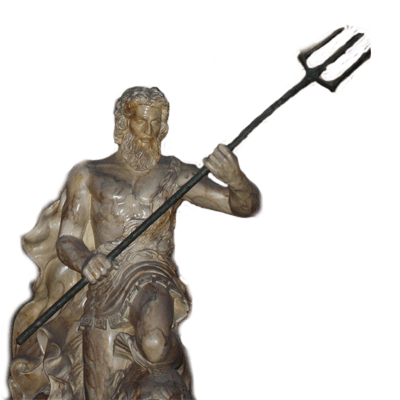
| Poseidon | Neptune | God of the Sea |
| Rhea | Ops | Mother of Zeus / Wife of Cronus |
| Selene | Luna | Goddess of the Moon |
| Uranus | Uranus | Father of the Titans |
| Zeus | Jupiter | King of the Gods |
Afterlife

The Greeks believed in an underworld, where the spirits of dead mortals went. The underworld was also known as Hades, placed under the surface of the earth. Each spirit would be judged by the deeds they performed in life to determine if they would be allowed to go to paradise, called Elysium, or be punished in a place of torment, called Tartarus.
It was a common belief that without the proper burial rituals, the spirit of the person wouldn’t be able to find the underworld and would be stuck haunting the ‘upper’ world as a ghost.
Practices
Ceremonies & Sacrifices
Greek worshipers sacrificed animals to appease the gods, usually with songs and prayers. The animals were burned and eaten by the people and served in banquets. These sacrifices were performed to invoke the gods for a blessing or to gain their favour for some event. The sacrifices could be to the name of any one of their numerous gods.
These ceremonies and rituals were typically performed at an altar to the god they would try to invoke. People, cults or rituals would often be specifically devoted to one, or a patron, god or goddess. The people would pay tribute to the altars or statues of the gods with food, tokens, or precious objects.
Criticism & Apologetics
Ancient Religions
Considering that the tales of this ancient mythology are quite fantastic and poetic, there is no indication that any of it should be taken literally. However, just as with any legend or obscured poetry, it may have been based on some historic truth that can be used to parallel literature or facts from other cultures, or findings in archaeology.
Ancient mythologies can also be used to help us understand the people of ancient times, and to help create a road map to correctly deduce the possibility that each ancient culture had some sort of significant tie to one another. Then, to us, this information helps us “connect the dots” from one ancient civilisation to another.
References
Babylon – Mother of all False World Religions
British Museum – Ancient Greece
Herodotus of Halicarnassus, a Greek polis in Asia Minor, excerpts from The Histories, ca. 430 b.c.
R.A. Segal, Theorising about Mythology, University of Mass. Press. 1999, ISBN 978-1-55849-191-5
M. Reinhold, The Generation Gap in Antiquity
L. Edmunds, Approaches to Greek Myth