World Religions – Abrahamic Religions – Islam & Muslims
Cresent Moon – Islam
Table of Contents
Overview – Islam
The Religion of Islam is a monotheistic Abrahamic religion that originated in the 7th century in the Arabian Peninsula. It centers on the belief in one God, known in Arabic as Allah, and follows the teachings of the prophet Muhammad, who is regarded by Muslims as the final messenger in a line of prophets that includes figures such as Abraham, Moses, and Jesus.
The primary sacred text of Islam is the Qur’an, which Muslims believe to be the literal word of God as revealed to Muhammad over a period of approximately 23 years. In addition to the Qur’an, Islamic belief and practice are informed by the Hadith—recorded sayings and actions of Muhammad—which, along with later interpretive traditions, help define doctrine, law, and daily religious life.
Islam is one of the world’s largest religions, with over a billion adherents across diverse cultures and regions. While there are variations within the faith—most notably between Sunni and Shia branches—core beliefs remain centered on the absolute oneness of God (Tawhid), submission to His will, and accountability on the Day of Judgment.
From an external and comparative perspective, Islam shares some historical connections with Judaism and Christianity, particularly in its recognition of many of the same biblical figures. However, it presents different theological claims regarding the nature of God, the identity of Jesus, the authority of scripture, and the means of salvation. These similarities and differences make Islam one of the most significant religions to understand in the context of biblical Christianity and global religious dialogue.
Historical Origin and Development
Islam originated in the early 7th century in the Arabian Peninsula, a region characterized at the time by tribal societies, trade networks, and a mixture of polytheistic, Jewish, and Christian influences. The city of Mecca served as a major religious and commercial center, housing the Kaaba—a sacred sanctuary that functioned as a focal point for regional pilgrimage.
Pre-Isalmic
The city of Mecca served as a major religious and commercial center, housing the Kaaba—a sacred sanctuary that functioned as a focal point for regional pilgrimage. The Kaaba was under the custodianship of the Quraysh tribe, to which Muhammad belonged, and played a central role in the religious and economic life of Mecca. Prior to Islam, the Kaaba was widely understood to have contained numerous tribal idols representing various Arabian deities, with historical sources often referencing figures such as Hubal, al-Lat, al-Uzza, and Manat among those venerated in the region.
In pre-Islamic Arabia, Arab tribes lived primarily in the Arabian Peninsula, located between the African and Indian tectonic plates.
This environment reflects the broader polytheistic religious landscape of pre-Islamic Arabia, into which Muhammad’s message of strict monotheism was introduced. While polytheistic practices were dominant in Meccan society, the broader Arabian context also included Jewish and Christian communities. This environment reflects the religious landscape into which Muhammad’s message of strict monotheism was introduced.
Mohammad’s Life
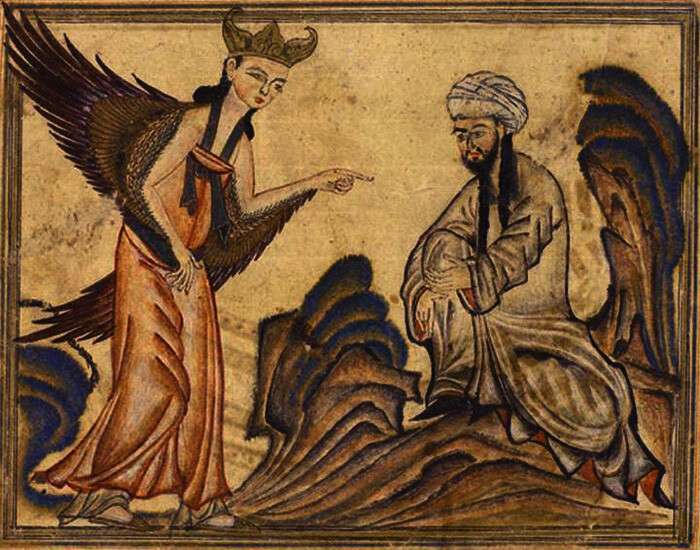
According to Islamic tradition, Muhammad ibn Abdullah (c. 570–632 AD), a merchant from Mecca, began receiving revelations around 610 AD, which he attributed to the angel Gabriel. These revelations, delivered over approximately 23 years, were later compiled into the Qur’an. Muhammad’s early message emphasized strict monotheism, moral accountability, and a call to abandon idolatry, which brought him into conflict with Meccan authorities.
Due to increasing opposition, Muhammad and his followers migrated to the city of Yathrib (later known as Medina) in 622 AD—an event known as the Hijra, which marks the beginning of the Islamic calendar. In Medina, Muhammad assumed both religious and political leadership, establishing a structured community governed by Islamic principles.
Over time, tensions between Mecca and Medina led to a series of conflicts. Muhammad eventually returned to Mecca, where the city was brought under his control and the Kaaba was rededicated to the worship of one God. By the time of his death in 632 AD, much of the Arabian Peninsula had come under Islamic influence.
Early Expansion
Following Muhammad’s death, leadership passed to a series of successors known as caliphs. Under the Rashidun Caliphate and subsequent Islamic empires, Islam expanded rapidly beyond Arabia into the Middle East, North Africa, and parts of Europe and Asia. This expansion was accompanied by the development of Islamic law, theology, and scholarship, which continued to shape the religion in the centuries that followed.
While Islamic tradition presents a unified account of these events, historical study also examines the broader cultural, political, and religious context of the region, including interactions with existing Jewish and Christian communities. These early developments are essential for understanding both the formation of Islamic doctrine and its relationship to earlier Abrahamic traditions.
Founder – Mohammad Ibn Abdullah
Muhammad ibn Abdullah (c. 570–632 AD) is regarded within Islam as the final prophet and messenger of God. He was born in Mecca into the Quraysh tribe and was known in early life as a merchant. Islamic tradition records that he was recognized among his peers for qualities such as trustworthiness and integrity prior to his prophetic calling, often referred to by the title al-Amin (“the trustworthy”).
Around the age of 40, Muhammad is said to have begun receiving revelations while meditating in a cave near Mecca. These revelations, which he attributed to the angel Gabriel, continued over a period of approximately 23 years and were later compiled into the Qur’an, the central sacred text of Islam.
During the early years of his ministry in Mecca, Muhammad proclaimed a message centered on the oneness of God, moral accountability, and the rejection of idol worship. This message brought opposition from Meccan leaders, particularly as it challenged the religious and economic structures associated with the Kaaba.
Following the migration to Medina in 622 AD, Muhammad’s role expanded to include not only that of a religious leader but also a political and military leader. In this capacity, he governed the growing Muslim community, established agreements among various groups, and led or authorized a number of conflicts during this period.
Historical and interfaith discussions have also examined aspects of Muhammad’s life that are viewed differently across traditions. Islamic sources, particularly early Hadith collections such as Sahih al-Bukhari, report that Muhammad’s wife Aisha was betrothed at a young age and that the marriage was later consummated when she was nine years old.
By the later years of his life, Muhammad had consolidated leadership over much of the Arabian Peninsula. Upon his death in 632 AD, he left behind a rapidly growing religious and political movement that would continue to expand under his successors.
Early Islamic sources also record an incident following the Battle of Khaybar in which Muhammad was given food that had been poisoned. According to these accounts, he tasted the food and warned others, while one of his companions consumed more and later died. Some traditions report that Muhammad continued to experience the effects of this event and referenced it during his final illness. This episode has been interpreted in different ways within Islamic tradition and has also been examined in interfaith discussions concerning prophetic authority and the nature of divine protection.
“ I still feel the pain from the food I ate at Khaybar… and now I feel as if my aorta is being cut.” – Sahih al-Bukhari 4428 (Book 64, Hadith 250 in some editions, often listed in the Book of Military Expeditions by Al-Maghazi).
Primary Texts and Sacred Literature
Islamic belief and practice are grounded in a collection of primary texts that, together, form the foundation for theology, law, and daily life. These sources vary in authority and function, but all play a significant role in shaping Islamic tradition.
The Qur’an
The Qur’an is the central and most authoritative sacred text of Islam. Muslims believe it to be the literal word of God (Allah), revealed to Muhammad through the angel Gabriel over a period of approximately 23 years. It is written in Arabic and is regarded within Islam as the final and complete revelation, confirming and superseding previous scriptures. The Qur’an is organized into chapters (surahs) and verses (ayahs), addressing themes such as the nature of God, moral conduct, guidance for personal and communal life, and accounts of earlier prophets.
Within Islamic belief, the Qur’an is considered perfectly preserved and unchanged since its revelation. From a historical and textual perspective, the compilation and standardization of the Qur’an—particularly during the early caliphates—has also been the subject of scholarly study, including examination of manuscript traditions and early transmission processes.
Authority Level: The Qur’an holds the highest level of authority in Islam and is considered the direct, infallible, and unalterable word of God. All other sources are interpreted in light of it and cannot override it.
Hadith Literature
The Hadith are collections of recorded sayings, actions, and approvals of Muhammad. These accounts serve as an essential source for understanding how Islamic teachings are to be practiced in daily life and are foundational for Islamic law (Sharia). Hadith literature was compiled over time and includes major collections such as Sahih al-Bukhari and Sahih Muslim, which are considered among the most authoritative in Sunni Islam.
Each Hadith is typically accompanied by a chain of transmission (isnad), which is used to assess its reliability. Scholars—both within and outside of Islam—have studied the processes by which Hadith were transmitted, collected, and authenticated, including the development of classification systems to distinguish between stronger and weaker reports.
Authority Level: Hadith are considered secondary to the Qur’an but remain highly authoritative, especially those classified as “authentic” (sahih). They are essential for interpreting the Qur’an and establishing legal and doctrinal practices.
Sira (Biographical Literature)
The Sira refers to the biographical accounts of Muhammad’s life. These writings provide narrative context for the events surrounding the Qur’an’s revelation and help explain the historical circumstances in which various teachings emerged.
One of the earliest known biographies is attributed to Ibn Ishaq (later preserved through Ibn Hisham), and these works remain important for understanding the life, actions, and leadership of Muhammad within Islamic tradition.
Authority Level: Sira literature is considered historically informative but carries less formal authority than the Qur’an and Hadith. Its value lies primarily in providing narrative context rather than establishing doctrine.
Tafsir (Interpretation and Commentary)
Tafsir refers to the body of interpretive literature that explains and analyzes the Qur’an. Because the Qur’an often addresses topics in concise or context-dependent ways, tafsir works provide historical background, linguistic analysis, and theological interpretation.
Over time, numerous tafsir traditions developed, reflecting different schools of thought within Islam. These interpretations play a key role in shaping how Qur’anic teachings are understood and applied.
Authority Level: Tafsir holds interpretive authority but is not considered divine or infallible. Its authority depends on the scholar, methodology, and alignment with accepted sources.
Development and Transmission
According to Islamic tradition, Muhammad was not formally literate (ummi), and the revelations he received were primarily transmitted orally during his lifetime. These revelations were memorized by followers and also recorded in written form on various materials such as parchment, bones, and palm leaves.
Following Muhammad’s death, concerns arose regarding the preservation of these revelations, particularly after the deaths of individuals who had memorized them. This led to efforts during the early caliphates—especially under Abu Bakr and later Uthman—to collect and standardize the text of the Qur’an. The Uthmanic codex is traditionally regarded as the basis for the standardized Qur’anic text used today.
From within Islamic belief, this process is understood as preserving the text faithfully. However, historical and textual scholarship has also examined early manuscript evidence, transmission methods, and the process of standardization. These studies explore questions related to compilation history, variant readings, and the development of the written text, contributing to ongoing academic discussion and debate regarding the preservation and transmission of early Islamic sources.
Core Beliefs and Practices
Islam is built upon a defined set of theological beliefs and religious practices that shape both personal faith and communal life. While variations exist across different traditions within Islam, the following represent the core teachings widely held across the majority of the Muslim world.
Muslim
“Islam” is commonly connected to the Arabic root s-l-m, associated with submission/surrender and related to peace; “Muslim” means one who submits to God. The word Islam is commonly understood to refer to submission or surrender to God, and the term is related to the Arabic root associated with peace and wholeness.
A Muslim is one who submits to God. In simple terms, Islam is a religion; a Muslim is a follower of that religion. Traditionally, a Muslim is identified by confession of the Shahada: “There is no god but Allah, and Muhammad is the messenger of Allah.” This declaration expresses both Islamic monotheism and Muhammad’s role as the final prophet.
Allah (God)
Historically, the name Allah predates Islam and is rooted in the wider Semitic vocabulary for deity. Most scholars understand it as related to the Arabic al-ʾilāh (“the God”), with deeper linguistic connections to earlier Semitic forms such as il, el, and eloah. In pre-Islamic Arabia, Allah was already known among Arab communities, including pagan settings, and appears to have been regarded by many as a high god, creator, and giver of rain.
At the same time, pre-Islamic Arabian religion remained polytheistic, with other deities such as al-Lāt, al-ʿUzzā, and Manāt also venerated.
There is one supreme god – (Sura 3.191, 5.73, 112.1-4)
Tawhid (The Oneness of God)
The central doctrine of Islam is Tawhid, the absolute oneness and uniqueness of God (Allah). God is understood to be singular, without partners, division, or association. Any form of associating others with God (shirk) is considered the gravest sin in Islamic theology.
God in Islam is viewed as transcendent, sovereign, and incomparable. He is not understood as entering into creation, and His nature is not described in relational or incarnational terms as found in Christian theology.
Lunar (Moon) Deity
The claim that Allah originated as a moon god is most commonly traced to Robert Morey, particularly through his 1994 book The Islamic Invasion. Morey argued that Islam’s concept of God developed out of pre-Islamic Arabian paganism, drawing connections between known lunar worship in the ancient Near East, the presence of idols such as Hubal in the Kaaba, and the later use of the crescent moon symbol in Islamic cultures.
His argument followed a chain of association: since moon worship existed in the region and the Kaaba housed pagan deities, he proposed that Allah must have originally been one of these—specifically a lunar deity—later redefined within Islamic monotheism. The theory gained popularity because it is simple and apologetically powerful, but it has been widely critiqued for overextending the available evidence.
Scholars note that it conflates different regions and religious systems, assumes symbolic continuity where historical gaps exist, and lacks direct textual or archaeological proof linking Allah to a moon god. While pre-Islamic Arabia did include polytheism and celestial worship, the dominant scholarly view is that Allah was already known as a high or creator god within that environment, not specifically a lunar deity. As a result, the “moon god” theory remains a contested and minority position, rather than a widely accepted historical conclusion.
Holy Places in Islam
Islam places significant importance on sacred locations, particularly those associated with worship, pilgrimage, and key events in early Islamic history.
Mecca
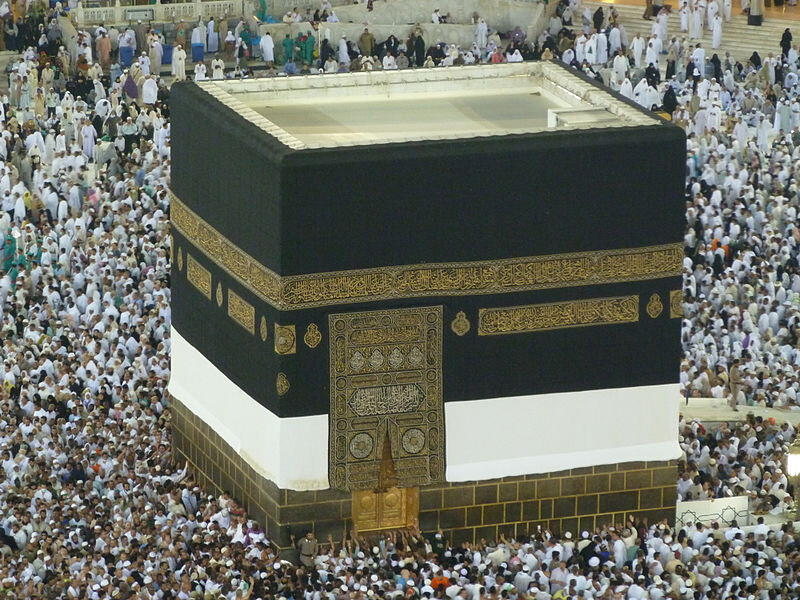
Mecca is the holiest city in Islam. It is traditionally regarded as the birthplace of Muhammad and is the site of the Kaaba, located within al-Masjid al-Haram (the Sacred Mosque). Muslims around the world face the Kaaba during daily prayer (qibla), and the annual pilgrimage (Hajj) is centered in and around Mecca. The wider sacred boundary of the city, known as the haram, includes important ritual sites such as Safa and Marwa, Mina, and the plain of Arafat.
The Kaaba is considered by Muslims to be the most sacred structure on earth and serves as the focal point of Islamic worship. The building is a stone structure of modest size (approximately 13 meters high), rectangular in shape, and draped in a black cloth (kiswah). In Islamic tradition, the Kaaba is believed to have been originally established by Abraham and his son Ishmael as a house dedicated to the worship of one God, and in some traditions, associated with an even earlier sacred site linked to Adam.
Kaabah Mosque – by PriorymanBlack Stone of Islam
Historical sources indicate that prior to Islam, the Kaaba functioned as a central shrine within Arabian polytheistic practice and contained numerous tribal idols. Deities such as Hubal, along with al-Lat, al-Uzza, and Manat, are frequently referenced in early accounts as being venerated in connection with the site. This reflects the broader religious environment of pre-Islamic Mecca, where pilgrimage and ritual activity were already established.
Embedded within the Kaaba is the Black Stone (al-Hajar al-Aswad), which holds significant ritual importance in Islamic practice. Islamic tradition teaches that the stone has a sacred origin, while its precise historical background prior to Islam remains a subject of discussion. While Islamic tradition attributes the Kaaba’s origins to Abrahamic foundations, there is no independent archaeological or contemporary historical evidence that directly verifies these early claims. As such, the understanding of its earliest origins depends largely on later textual and religious traditions.
Medina
Medina is the second-holiest city in Islam. It was the destination of Muhammad’s migration (Hijra) from Mecca and became the early center of the Muslim community. It is home to al-Masjid an-Nabawi (the Prophet’s Mosque), which contains the traditional burial site of Muhammad. Jerusalem also holds major religious significance in Islam, particularly through its association with the Night Journey (Isra and Mi’raj). It is home to al-Aqsa Mosque and the Dome of the Rock, and is regarded as one of the principal sacred locations in Islamic tradition.
Prophets and Revelation
Islam teaches that God has sent prophets throughout history to guide humanity, including figures such as Adam, Noah, Abraham, Moses, and Jesus. These individuals are regarded as true messengers who delivered God’s guidance to their respective peoples.
Muhammad is considered the final prophet (Seal of the Prophets), and the Qur’an is viewed as the final and complete revelation. Earlier scriptures—such as the Torah and the Gospel—are acknowledged but are generally understood within Islam to have been altered or corrupted over time.
Jesus in Islam
Jesus (Isa) holds a significant role in Islamic belief. He is regarded as a prophet, born of the virgin Mary, and a worker of miracles by God’s permission. However, Islam rejects the divinity of Jesus, the concept of the Trinity, and the crucifixion as understood in Christianity. Instead, Islamic teaching affirms that Jesus was not crucified but was raised by God, and that he will return in the future as part of the end times.
Salvation and Judgment
Islam teaches that all individuals will be held accountable before God on the Day of Judgment. Salvation is generally understood in terms of faith in God, obedience to His commands, and the balance of one’s deeds.
While God is described as merciful, there is no absolute assurance of salvation; final judgment rests with God. This framework emphasizes submission, moral conduct, and adherence to divine law.
God hates sinners – (Sura 7.53)
Those whose good deeds outweigh their bad will obtain paradise – ( Sura 3.135, 7.8-9, 21.47)
Paradise has voluptuous virgin women for sensual gratification – (Sura 55.56, 56.35-38, 78.31-33)
Those who are not Muslim will go to hell (2.24, 3.12)
No guarantee of salvation – The Quran says that if your good deeds outweigh your bad, you believe in Allah, and repent, you might go to heaven (Sura 3.135, 7.8-9, 21.47, 49.14, 66.8-9); There is no last-minute repentance (Sura 4.18)
The Five Pillars of Islam
These practices form the foundational framework for a Muslim’s religious life and reflect outward submission to God’s will. The Five Pillars represent the core acts of worship and practice in Islam:
Shahada – The declaration of faith: “There is no god but Allah, and Muhammad is the messenger of Allah.”
Salat – Ritual prayer performed five times daily
Zakat – Charitable giving to those in need
Sawm – Fasting during the month of Ramadan
Hajj – Pilgrimage to Mecca, required once if physically and financially able
Law and Daily Life (Sharia)
Islamic teaching extends beyond belief into a comprehensive system governing personal conduct, social relationships, and legal matters. This system, commonly referred to as Sharia, is derived primarily from the Qur’an and Hadith and interpreted through various legal schools. Sharia addresses areas such as worship, ethics, family structure, finance, and community order, reflecting the integration of religion and daily life within Islamic tradition.
Additional Beliefs
The Holy Spirit is the angel Gabriel (Sura 2.97, 16.102)
There will be an end of the world and judgment (Sura 35.33-37)
Jihad (Struggle and Warfare in Islamic Tradition)
The concept of Jihad (Arabic: “struggle” or “striving”) is an important and often discussed aspect of Islamic teaching. In its broadest sense, Jihad can refer to a personal or spiritual struggle to live in submission to God. However, Islamic texts and historical practice also include forms of external struggle, including armed conflict under certain conditions. Modern discussions of Jihad vary widely. Some emphasize its spiritual and ethical dimensions, while others focus on its historical and legal aspects related to conflict. As a result, the concept remains one of the most debated and interpreted teachings within Islam today.
Sunni Islam Perspective: Generally recognizes both spiritual and military dimensions of Jihad. Classical Sunni legal traditions developed rules governing warfare, including conditions, conduct, and authority under recognized leadership.
Shia Islam Perspective: Also affirms Jihad, but traditionally places greater emphasis on legitimate authority, often associating full military Jihad with the leadership of a rightful Imam. In some Shia traditions, certain forms of offensive Jihad are viewed as suspended until the return of the expected Imam.
Historical Context: Historically, the concept of Jihad has included both spiritual and military dimensions. In classical Islamic legal tradition, armed struggle was permitted under specific conditions, particularly in the context of defending or expanding Islamic rule. While these frameworks included rules governing conduct in warfare, the interpretation and application of Jihad have varied significantly across different periods and regions, and remain a subject of ongoing debate.
Major Branches of Islam
Islam is not a monolithic tradition. From its earliest history, differences in leadership, authority, and interpretation led to the development of distinct branches. The two largest are Sunni and Shia, with additional smaller movements that developed over time.
Sunni Islam (Majority Tradition)
Historical Origin: Sunni Islam traces its origin to the period immediately following Muhammad’s death in 632 AD. The central issue was leadership—specifically, who should succeed Muhammad as leader of the Muslim community. Those who supported the selection of leaders through consensus (beginning with Abu Bakr as the first caliph) became the foundation of what is now known as Sunni Islam. “Sunni” comes from Ahl al-Sunnah (“people of the tradition”), referring to adherence to the example (Sunnah) of Muhammad.
Key Characteristics:
Emphasis on the Qur’an and Hadith as primary sources
Acceptance of the first four caliphs (Abu Bakr, Umar, Uthman, Ali)
Development of established legal schools (madhhabs)
Leadership is not considered divinely appointed, but based on community recognition
Distinctives: Sunni Islam represents approximately 85–90% of Muslims worldwide and tends to emphasize continuity with early community leadership and established scholarly tradition.
Shia Islam
Historical Origin: Shia Islam developed from a dispute over succession following Muhammad’s death. Supporters of Ali ibn Abi Talib—Muhammad’s cousin and son-in-law—believed leadership should remain within Muhammad’s family. The term “Shia” comes from Shi‘at Ali (“party of Ali”). This division became more defined over time, especially following key historical events such as the martyrdom of Husayn ibn Ali at the Battle of Karbala in 680 AD.
Key Characteristics:
Leadership vested in a line of divinely guided figures known as Imams
Strong emphasis on the spiritual and authoritative role of these Imams
Distinct Hadith collections and legal traditions
Commemoration of Karbala (especially during Ashura)
Distinctives: Shia Islam differs from Sunni Islam primarily in its understanding of authority and leadership, viewing the Imams as uniquely appointed and guided. It represents a minority globally but is the majority in countries such as Iran.
Other Islamic Movements
In addition to Sunni and Shia Islam, several smaller branches and movements have developed throughout Islamic history:
Kharijites (Early Sect): One of the earliest groups to break away during the first Islamic civil wars. They held strict views on leadership and belief, asserting that any Muslim who committed a serious sin could be considered outside the faith. Though largely diminished, related groups (such as the Ibadi tradition) still exist today.
Ibadi Islam: A surviving branch with roots in early Islamic divisions, most prominently found in Oman. It maintains distinct theological and legal positions while differing from both Sunni and Shia traditions.
Sufism (Islamic Mysticism): Not a separate sect but a spiritual movement found within both Sunni and Shia Islam. Sufism emphasizes personal devotion, spiritual purification, and direct experiential knowledge of God.
Islam Comparison with Biblical Christianity (Primary Theological Differences)
While Islam and Christianity share certain historical connections and reference many of the same figures, their core theological claims differ significantly. These differences center on the nature of God, the identity of Jesus Christ, the means of salvation, and the authority of divine revelation.
Nature of God: Tawhid vs Trinity
Islam teaches Tawhid, the absolute oneness and indivisibility of God (Allah). God is understood to be singular, without partners, and entirely transcendent. Any division within God or association with others (shirk) is rejected as a fundamental violation of true monotheism. Biblical Christianity also affirms one God, but understands this unity as a Trinity—one God in three persons: Father, Son, and Holy Spirit. This is not seen as three gods, but as one divine being in a relational and personal unity. The key difference is not whether God is one, but how that oneness is understood. Islam emphasizes absolute singularity, while Christianity affirms a unified yet relational nature within God’s being.
“Say, He is Allah, One. Allah, the Eternal Refuge. He neither begets nor is born, Nor is there to Him any equivalent.” – Surah Al-Ikhlas (112:1–4)
“Do not say ‘Three’; desist—it is better for you. Indeed, Allah is but one God.” – Surah An-Nisa (4:171)
“They have certainly disbelieved who say, ‘Allah is the third of three.’” – Surah Al-Ma’idah (5:73)
In contrast, Christianity teaches that Jesus is the Son of God, fully divine and fully human. His crucifixion and resurrection are central to the Christian faith, representing God’s redemptive work for humanity. This represents one of the most fundamental differences between the two faiths: who Jesus is determines the entire structure of belief. In Islam, Jesus (Isa) is regarded as a prophet—honored, born of a virgin, and associated with miracles—but fully human and not divine. Islam explicitly rejects:
The divinity of Christ
The Sonship of Christ
The crucifixion as understood in Christianity
“The Messiah, son of Mary, was no more than a messenger…” – Surah Al-Ma’idah (5:75)
“They did not kill him, nor did they crucify him, but it was made to appear so…” – Surah An-Nisa (4:157)
“Indeed, I am the servant of Allah. He has given me the Scripture and made me a prophet.” – Surah Maryam (19:30)
“They have certainly disbelieved who say, ‘Allah is the Messiah, the son of Mary.’ … Indeed, he who associates others with Allah—Allah has forbidden him Paradise, and his refuge is the Fire.” – Surah Al-Ma’idah (5:72)
“They have certainly disbelieved who say, ‘Allah is the third of three.’ And there is no god except one God…” – Surah Al-Ma’idah (5:73)
“It is not for Allah to take a son; exalted is He! When He decrees a matter, He only says to it, ‘Be,’ and it is.” – Surah Maryam (19:35)
“And they say, ‘The Most Merciful has taken a son.’ You have done an atrocious thing… It is not appropriate for the Most Merciful that He should take a son.” – Surah Maryam (19:88–92)
“They say, ‘Allah has taken a son.’ Exalted is He; rather, to Him belongs whatever is in the heavens and the earth…” – Surah Al-Baqarah (2:116)
“And [beware] the Day when Allah will say, ‘O Jesus, Son of Mary, did you say to the people, “Take me and my mother as deities besides Allah?”’…” – Surah Al-Ma’idah (5:116)
Salvation: Works and Submission vs Grace and Redemption
Islam teaches that individuals are judged by God based on faith, obedience, and deeds. While God is described as merciful, there is no guaranteed assurance of salvation; final judgment rests with God. Christianity teaches that salvation is a gift of grace, not earned by works, but received through faith in Jesus Christ. Good works are understood as the result of salvation, not the means of achieving it. The contrast here is between:
Submission and accountability within divine law
Redemption and assurance through Christ
“So whoever does an atom’s weight of good will see it, and whoever does an atom’s weight of evil will see it.” – Surah Az-Zalzalah (99:7–8)
“It will have [the consequence of] what it has earned…” – Surah Al-Baqarah (2:286)
“Those whose scales are heavy—it is they who will be successful. But those whose scales are light—those are the ones who have lost their souls…” – Surah Al-Mu’minun (23:102–103)
In Islam, the primary relationship between humans and God is one of submission. God is sovereign, transcendent, and distinct from creation, and the believer’s role is to obey and submit to His will. In Christianity, while God is also sovereign, the relationship is described in more relational and personal terms, including adoption as children of God. Through Christ, believers are invited into a restored relationship with God, not only as subjects but as sons and daughters.
“And I did not create the jinn and mankind except to worship Me.” – Surah Adh-Dhariyat (51:56)
“When his Lord said to him, ‘Submit,’ he said, ‘I have submitted to the Lord of the worlds.’” – Surah Al-Baqarah (2:131)
“Indeed, the religion in the sight of Allah is Islam.” – Surah Al-Imran (3:19)
Revelation and Authority
Islam teaches that the Qur’an is the final and complete revelation, delivered through Muhammad as the final prophet. Earlier scriptures (such as the Torah and Gospel) are acknowledged but generally considered to have been altered over time. Christianity teaches that divine revelation is fulfilled in Jesus Christ, with the Bible serving as the inspired record of that revelation. Rather than expecting a final prophet, Christianity holds that God’s revelation is completed in Christ. This creates a direct contrast:
Islam: final prophet + final book
Christianity: final revelation in a person (Christ)
“Muhammad is… the Messenger of Allah and the seal of the prophets.” – Surah Al-Ahzab (33:40)
“And We have revealed to you the Book in truth, confirming what came before it and as a criterion over it.” – Surah Al-Ma’idah (5:48)
“This Qur’an was revealed to me that I may warn you and whomsoever it reaches.” – Surah Al-An’am (6:19)
Qur’an: single source, standardized after Muhammad
Textual History
Thousands of manuscripts with traceable transmission
Standardized text under Uthman; variant codices existed before
Verification
Prophecy, miracles, historical corroboration
Primarily a linguistic claim of perfection and internal consistency
View of Sin
Requires atonement; cannot be removed by works alone
Can be forgiven through repentance and good deeds
View of Love
God is love, demonstrated through sacrifice
Allah shows mercy, but love is conditional on obedience
Relationship to God
Adopted as children of God
Servants/slaves of Allah
Hope
Assured salvation and eternal life through Christ
Hope in Allah’s mercy without certainty
Qur’an vs Bible (Doctrine and Revelation)
Both Islam and Christianity claim divine revelation through sacred scripture. In Islam, the Qur’an is regarded as the final and complete word of God, revealed to Muhammad as the last prophet. In Christianity, the Bible is understood as the inspired record of God’s revelation, culminating in the person and work of Jesus Christ. While the Qur’an affirms that earlier scriptures were given by God, it also presents teachings that differ significantly from the biblical text, raising important questions regarding consistency, preservation, and authority.
The Qur’anic Affirmation of the Bible
The Qur’an explicitly affirms that God revealed earlier scriptures, including the Torah and the Gospel. “We sent Jesus… confirming the Torah… and We gave him the Gospel…” – Surah Al-Ma’idah (5:46–47). It further states, “And We have revealed to you the Book in truth, confirming what came before it and as a criterion over it.” – Surah Al-Ma’idah (5:48). These passages indicate that the Qur’an recognizes previous revelations as originating from God and presents itself as confirming them.
It is He Who sent down to thee (step by step), in truth, the Book, confirming what went before it; and He sent down the Law (of Moses) and the Gospel (of Jesus) before this, as a guide to mankind, and He sent down the criterion (of judgment between right and wrong). – Sura 3.2-3
163. We have sent thee inspiration, as We sent it to Noah and the Messengers after him: we sent inspiration to Abraham, Isma’il, Isaac, Jacob and the Tribes, to Jesus, Job, Jonah, Aaron, and solomon, and to David We gave the Psalms. 164. Of some apostles We have already told thee the story; of others We have not;- and to Moses Allah spoke direct; – Sura 4.163-164
46. And in their footsteps We sent Jesus the son of Mary, confirming the Law that had come before him: We sent him the Gospel: therein was guidance and light, and confirmation of the Law that had come before him: a guidance and an admonition to those who fear Allah.
47. Let the people of the Gospel judge by what Allah hath revealed therein. If any do fail to judge by (the light of) what Allah hath revealed, they are (no better than) those who rebel.
48. To thee We sent the Scripture in truth, confirming the scripture that came before it, and guarding it in safety: so judge between them by what Allah hath revealed, and follow not their vain desires, diverging from the Truth that hath come to thee. To each among you have we prescribed a law and an open way. If Allah had so willed, He would have made you a single people, but (His plan is) to test you in what He hath given you: so strive as in a race in all virtues. The goal of you all is to Allah. it is He that will show you the truth of the matters in which ye dispute;
49. And this (He commands): Judge thou between them by what Allah hath revealed, and follow not their vain desires, but beware of them lest they beguile thee from any of that (teaching) which Allah hath sent down to thee. And if they turn away, be assured that for some of their crime it is Allah.s purpose to punish them. And truly most men are rebellious. – Sura 5.46-49
The Quran Affirms Allah’s Words Can Not Be Changed
The Qur’an explicitly affirms that God revealed earlier scriptures, including the Torah and the Gospel. “We sent Jesus… confirming the Torah… and We gave him the Gospel…” – Surah Al-Ma’idah (5:46–47). It further states, “And We have revealed to you the Book in truth, confirming what came before it and as a criterion over it.” – Surah Al-Ma’idah (5:48). These passages indicate that the Qur’an recognizes previous revelations as originating from God and presents itself as confirming them.
The Qur’an also emphasizes the enduring nature of God’s word. “None can change the words of Allah.” – Surah Al-An’am (6:34). Similarly, “There is none who can alter the words of Allah.” – Surah Al-Kahf (18:27). Within Islamic interpretation, these statements are often understood to refer to the certainty and authority of God’s decrees. However, when read alongside the Qur’an’s affirmation of earlier scriptures, they raise an important question regarding how previously revealed texts could be altered if the word of God is described as unchangeable. This tension becomes central to the broader discussion of preservation and textual integrity.
Rejected were the apostles before thee: with patience and constancy they bore their rejection and their wrongs, until Our aid did reach them: there is none that can alter the words (and decrees) of Allah. Already hast thou received some account of those apostles. – Sura 6.34
There is not an animal (that lives) on the earth, nor a being that flies on its wings, but (forms part of) communities like you. Nothing have we omitted from the Book, and they (all) shall be gathered to their Lord in the end. – Sura 6.38
The word of thy Lord doth find its fulfillment in truth and in justice: None can change His words: for He is the one who heareth and knoweth all. – Sura 6.115
For them are glad tidings, in the life of the present and in the Hereafter; no change can there be in the words of Allah. This is indeed the supreme felicity. – Sura 10.64
Muslims must acknowledge the Bible as truth – Same God (Allah)
The Qur’an also presents a theological continuity between Muslims and the “People of the Book” (Jews and Christians), affirming a shared belief in the same God and acknowledging earlier revelation as originating from Him. “Recite what is sent of the Book by inspiration to thee, and establish regular Prayer…” – Surah Al-Ankabut (29:45). It further states, “We believe in the revelation which has come down to us and in that which came down to you; our God and your God is one…” – Surah Al-Ankabut (29:46). This reinforces the Qur’an’s claim that the God of Islam is the same as the God of earlier biblical revelation, while also affirming continuity between the scriptures.
Recite what is sent of the Book by inspiration to thee, and establish regular Prayer: for Prayer restrains from shameful and unjust deeds; and remembrance of Allah is the greatest (thing in life) without doubt. And Allah knows the (deeds) that ye do. – Sura 29.45
And dispute ye not with the People of the Book, except with means better (than mere disputation), unless it be with those of them who inflict wrong (and injury): but say, “We believe in the revelation which has come down to us and in that which came down to you; Our Allah and your Allah is one; and it is to Him we bow (in Islam).” – Sura 29.46
The Quran claims that you can use the Bible to test its accuracy
The Qur’an also directs those in doubt to consult earlier scriptures. “So if you are in doubt about what We have revealed to you, then ask those who have been reading the Scripture before you.” – Surah Yunus (10:94). This passage indicates that the existing scriptures available at the time were considered a valid point of reference for confirming revelation.
This raises an important question within the broader discussion of textual integrity. If the Torah and Gospel were already corrupted or altered prior to the time of Muhammad, it is not immediately clear why they would be presented as a reliable standard for verification. Conversely, if they were sufficiently preserved to serve as a point of confirmation, this introduces tension with later claims that the biblical text had been changed.
Sura 10:94- .” “If you have any doubt regarding what is revealed to you from your Lord, then ask those who read the previous scripture”
The Quran’s Question of the Corruption of the Bible
Despite affirming earlier scriptures, Islamic teaching generally holds that the Bible has been corrupted or altered over time. However, the Qur’an does not provide a detailed historical account of when such corruption occurred, who was responsible, or which specific portions were changed. At the same time, the Qur’an directs those in doubt to consult earlier scriptures: “So if you are in doubt… then ask those who have been reading the Scripture before you.” – Surah Yunus (10:94). This creates a tension in which the Bible is both affirmed as revelation and later regarded as unreliable, without a clearly defined point of divergence.
“We sent Jesus… confirming the Torah… and We gave him the Gospel…” – Surah Al-Ma’idah (5:46–47)
“And We have revealed to you the Book in truth, confirming what came before it and as a criterion over it.” – Surah Al-Ma’idah (5:48)
“Say, ‘We believe in Allah and what has been revealed to us and what was revealed to Abraham… Moses and Jesus…’” – Surah Al-Baqarah (2:136)
Doctrinal Contradictions
The Qur’an presents teachings that differ in essential ways from the Bible, particularly on central doctrines. Regarding the crucifixion, the Qur’an states, “They did not kill him, nor did they crucify him, but it was made to appear so…” – Surah An-Nisa (4:157), which directly contradicts historic events and the central event of the New Testament and the foundation of Christian salvation.
On the nature of God, the Qur’an declares, “They have certainly disbelieved who say, ‘Allah is the third of three.’” – Surah Al-Ma’idah (5:73), rejecting the Trinity as understood in Christianity. Concerning the Sonship of Christ, it states, “Indeed, he who associates others with Allah—Allah has forbidden him Paradise, and his refuge is the Fire.” – Surah Al-Ma’idah (5:72). These positions stand in direct opposition to core Christian doctrines concerning the identity of Jesus and the nature of God.
That they said (in boast), “We killed Christ Jesus the son of Mary, the Apostle of Allah”;- but they killed him not, nor crucified him, but so it was made to appear to them, and those who differ therein are full of doubts, with no (certain) knowledge, but only conjecture to follow, for of a surety they killed him not: – Sura 4.157-159
Interpretive and Theological Tensions
Some Qur’anic passages appear to reflect understandings of Christian doctrine that differ from historic biblical teaching. It would seem to indicate that the writers received a majority of their Chriastian doctrinal understanding from Catholic monks, rather than traditional Biblical theology. For example, “And [beware] the Day when Allah will say, ‘O Jesus, Son of Mary, did you say to the people, “Take me and my mother as deities besides Allah?”’…” – Surah Al-Ma’idah (5:116).
This passage has been interpreted as reflecting either a misunderstanding of the Trinity or an engagement with particular sectarian beliefs present in the region at the time. In addition, the Qur’an’s affirmation of earlier scriptures alongside later claims of their alteration contributes to ongoing debate about internal consistency in its treatment of prior revelation.
O People of the Book! Commit no excesses in your religion: Nor say of Allah aught but the truth. Christ Jesus the son of Mary was (no more than) an apostle of Allah, and His Word, which He bestowed on Mary, and a spirit proceeding from Him: so believe in Allah and His apostles. Say not “Trinity” : desist: it will be better for you: for Allah is one Allah: Glory be to Him: (far exalted is He) above having a son. To Him belong all things in the heavens and on earth. And enough is Allah as a Disposer of affairs. – Sura 4.17
In blasphemy indeed are those that say that Allah is Christ the son of Mary. Say: “Who then hath the least power against Allah, if His will were to destroy Christ the son of Mary, his mother, and all every – one that is on the earth? For to Allah belongeth the dominion of the heavens and the earth, and all that is between. He createth what He pleaseth. For Allah hath power over all things.” – Sura 5.17
Christ the son of Mary was no more than an apostle; many were the apostles that passed away before him. His mother was a woman of truth. They had both to eat their (daily) food. See how Allah doth make His signs clear to them; yet see in what ways they are deluded away from the truth! – Sura 5.75
and behold! Allah will say: “O Jesus the son of Mary! Didst thou say unto men, worship me and my mother as gods in derogation of Allah.?” He will say: “Glory to Thee! Never could I say what I had no right (to say). Had I said such a thing, thou wouldst indeed have known it. Thou knowest what is in my heart, Thou I know not what is in Thine. For Thou knowest in full all that is hidden. – Sura 5.116
Catholic Teachings
From a biblical perspective, this raises a deeper theological concern. The historic Christian doctrine of the Trinity has never taught that God consists of three separate gods, nor that God requires a consort or includes Mary as part of the Godhead. The suggestion of such a structure reflects categories foreign to the Bible and more consistent with surrounding religious frameworks than with established Christian theology.
If the Qur’an is presenting a divinely inspired corrective to prior revelation, it would be expected to accurately represent the doctrines it critiques. The presence of these depictions, along with the Qur’an’s simultaneous affirmation and later rejection of earlier scriptures, contributes to ongoing debate regarding the consistency and source of its theological claims.
Say: “Praise be to Allah, who begets no son, and has no partner in (His) dominion: Nor (needs) He any to protect Him from humiliation: yea, magnify Him for His greatness and glory!” – Sura 17.111
No son did Allah beget, nor is there any god along with Him: (if there were many gods), behold, each god would have taken away what he had created, and some would have lorded it over others! Glory to Allah! (He is free) from the (sort of) things they attribute to Him! – Sura 23.93
Yet they make the Jinns equals with Allah, though Allah did create the Jinns; and they falsely, having no knowledge, attribute to Him sons and daughters. Praise and glory be to Him! (for He is) above what they attribute to Him!
To Him is due the primal origin of the heavens and the earth: How can He have a son when He hath no consort? He created all things, and He hath full knowledge of all things. – Sura 6.100-101
‘And Exalted is the Majesty of our Lord: He has taken neither a wife nor a son. – Sura 72.3
Islam teaches that the Qur’an is the direct and final word of God, revealed to Muhammad over a period of approximately twenty-three years and preserved as a single, unified text. This form of revelation is commonly understood as verbal or dictation-style, with Muhammad functioning as the recipient and transmitter of the message. The Qur’an presents itself as the final authority, confirming previous scriptures while also serving as the ultimate standard over them.
In contrast, the Bible presents a fundamentally different model of revelation. Rather than coming through a single individual, it was written over centuries by multiple authors, across different historical contexts, genres, and literary styles, yet unified in its theological message.
This progressive revelation culminates not in a final book, but in the person of Jesus Christ. “God, who at various times and in various ways spoke in time past to the fathers by the prophets, has in these last days spoken to us by His Son…” – Hebrews 1:1–2. This creates a direct contrast: Islam centers final authority in a later prophet and a single dictated text, while Christianity affirms that God’s ultimate and complete revelation has already been given in Christ, not through a subsequent messenger.
Quran Prophecy & Prophetic Fulfillment
One of the key distinctions between the Bible and the Qur’an is the role of prophecy and supernatural validation. The Bible consistently presents prophecy as a primary means by which God confirms His authority and distinguishes Himself from false gods. For example, “Present your case… declare to us the things to come… tell us what is to come hereafter, that we may know that you are gods…” – Isaiah 41:21–23. Throughout the biblical narrative, prophecy is used to demonstrate divine foreknowledge, often accompanied by miracles and fulfilled predictions that span generations.
In contrast, the Qur’an does not emphasize fulfilled prophecy in the same manner as a primary test of divine origin; it contains very little prophetic information, if any at all. Instead, it appeals more directly to the authority of its revelation, its message, and its linguistic form. This represents a different framework for validation. If both texts claim to originate from the same God, this difference raises an important question: whether the method of confirming divine revelation remains consistent with the pattern established in earlier scripture, where prophecy and fulfillment serve as central evidence of divine authorship.
The Roman Victory (Most Cited Example)
“The Romans have been defeated… but they, after their defeat, will overcome within a few years…” – Surah Ar-Rum (30:2–4)
Context:
Refers to the Byzantine (Eastern Roman) Empire being defeated by the Persians. Predicts they will recover “within a few years” (bid‘ sinīn, often interpreted as 3–9 years)
Claimed Fulfillment:
The Byzantines later defeated the Persians under Emperor Heraclius (early 7th century)
Scholarly Notes:
This is considered the strongest Qur’anic predictive statement
Debate exists over:
Timing flexibility (“few years” is broad)
Whether the outcome was already trending politically
Preservation of Pharaoh’s Body
“Today We will save you in body so that you may be a sign for those after you…” – Surah Yunus (10:92)
Context:
Refers to Pharaoh after the Exodus narrative
Claimed Fulfillment:
Often connected to the discovery of preserved Egyptian mummies
Scholarly Notes:
This is retrospective interpretation, not a time-specific predictive prophecy
The text itself does not identify a specific Pharaoh or timeline
Spread / Victory of Islam
“Allah has promised those who believe… that He will surely grant them succession in the land…” – Surah An-Nur (24:55)
Context:
Promise of expansion and establishment of the Muslim community
Claimed Fulfillment:
Early Islamic conquests after Muhammad’s death
Scholarly Notes:
More of a general promise than a specific, testable prophecy
Protection of the Qur’an
“Indeed, it is We who sent down the Qur’an and indeed, We will be its guardian.” – Surah Al-Hijr (15:9)
Context:
Claim of preservation
Claimed Fulfillment:
Used to support the belief that the Qur’an has been perfectly preserved
Scholarly Notes:
This is a theological claim, not a time-bound prophecy
Evaluated through textual criticism rather than predictive verification
Internal Textual and Logical Tensions in the Qur’an
The Qur’an presents itself as a clear and consistent revelation from God. At the same time, both Islamic scholarship and external analysis have identified passages that require reconciliation through interpretation, context, or later explanation. The following examples highlight areas where tensions have been observed within the text, particularly where multiple statements appear to address the same subject in different ways.
Early Qur’anic Codices and Compilation (Original Books)
There were multiple early collections of the Qur’an in circulation after Muhammad died in 632 AD. Among the most prominent were:
Hafsa → custodian of a manuscript
Abdullah ibn Mas‘ud → companion with his own codex
Ubayy ibn Ka‘b → companion with his own codex
Following the death of Muhammad in 632 AD, the Qur’an was not immediately preserved as a single, standardized written text. Instead, it existed in a combination of oral recitation and written fragments, alongside collections maintained by various companions.
Early Islamic sources record that several companions possessed their own codices (written collections) of the Qur’anic material, including those associated with Hafsa (daughter of Umar), Abdullah ibn Mas‘ud, and Ubayy ibn Ka‘b. These collections were regarded as containing material from the recitations attributed to Muhammad, though they were not fully standardized or identical in arrangement.
During the caliphate of Uthman ibn Affan (mid-7th century), concerns arose regarding differences in recitation and regional variations. In response, Uthman commissioned a standardization effort, appointing Zaid ibn Thabit and a committee to compile an official version of the Qur’an.
This recension, often referred to as the Uthmanic codex, was then distributed to major centers of the Islamic world. At the same time, other codices and variant written materials were reportedly ordered to be removed from circulation to preserve the unity of recitation and prevent dispute.
This historical process carries significant implications. If the Qur’an is understood as the direct and perfectly preserved word of God, the existence of multiple codices in active use raises questions about the nature and extent of early textual variation.
The deliberate removal and destruction of alternative codices further introduces discussion about why such measures were necessary if all existing copies equally represented the same unaltered revelation. While Islamic tradition views this as a step taken to preserve unity and prevent division, it also highlights the role of human agency in the transmission and standardization of the text.
The central role of Zaid ibn Thabit and the standardization process itself has therefore been a focal point in both classical and modern discussions. Although this effort is understood within Islam as preserving the authentic text, it also reflects a stage in which the form of the Qur’an was consolidated following the existence of multiple early collections. Modern manuscript discoveries have added further depth to this discussion.
Early Qur’anic manuscripts, such as those found in Sana’a, Yemen, show variations in early textual layers and writing traditions. Scholars such as Gerd R. Puin have noted that these manuscripts provide insight into the developmental history of the text and suggest that the process of textual stabilization occurred over time rather than existing in a single fixed form from the beginning.
Creation of Man
The Qur’an describes the origin of man using multiple forms of expression:
“Created man from a clot (congealed blood).” – Surah Al-Alaq (96:2)
“We created man from sounding clay…” – Surah Al-Hijr (15:26)
“Indeed, the example of Jesus to Allah is like that of Adam. He created Him from dust…” – Surah Aal-E-Imran (3:59)
“Does man not remember that We created him before, while he was nothing?” – Surah Maryam (19:67)
These passages are often interpreted symbolically or sequentially within Islamic tradition, but when read together, they raise questions about whether they describe stages of creation or present differing descriptions of origin.
Forgiveness of Idolatry
The Qur’an strongly condemns associating partners with God:
“Indeed, Allah does not forgive association with Him…” – Surah An-Nisa (4:48)
At the same time, other passages describe instances where forgiveness appears to be extended following acts of idolatry:
“Then they took the calf after clear signs had come to them, but We forgave that…” – Surah An-Nisa (4:153)
This creates discussion regarding whether idolatry is absolutely unforgivable or conditionally forgivable depending on repentance and context.
Can Allah’s Words Change?
The Qur’an affirms that God’s words cannot be changed:
“None can change the words of Allah.” – Surah Al-An’am (6:34)
“There is none who can alter His words.” – Surah Al-An’am (6:115)
Yet other passages describe a process in which revelations are replaced:
“None of Our revelations do We abrogate… but We bring one better than it or similar to it…” – Surah Al-Baqarah (2:106)
“And when We substitute one revelation in place of another…” – Surah An-Nahl (16:101)
This has been addressed through the doctrine of abrogation, though it raises questions about how unchanging words relate to replaced revelations.
The Death of Pharaoh
Different passages describe Pharaoh’s end in ways that are interpreted differently:
“And We took the Children of Israel across the sea… and We saved you in body that you may be a sign…” – Surah Yunus (10:90–92)
“So We drowned him and those with him all together.” – Surah Al-Isra (17:103)
These passages are often harmonized by suggesting Pharaoh drowned but his body was preserved, though the descriptions emphasize different outcomes.
Wine: Forbidden or Permitted?
The Qur’an condemns intoxicants:
“O you who believe, indeed intoxicants… are an abomination…” – Surah Al-Ma’idah (5:90)
At the same time, descriptions of Paradise include wine:
“A description of Paradise… rivers of wine, delicious to those who drink…” – Surah Muhammad (47:15)
“And they will be given to drink pure wine…” – Surah Al-Mutaffifin (83:25)
This distinction is typically understood as a difference between earthly prohibition and heavenly reward, though it reflects a contrast in how wine is presented.
Do Muslims, Jews, and Christians Worship the Same God?
Some passages emphasize continuity:
“We believe in Allah… and what was revealed… to Moses and Jesus…” – Surah Al-Baqarah (2:136)
“Our God and your God is one…” – Surah Al-Ankabut (29:46)
Other passages emphasize distinction:
“To you your religion, and to me mine.” – Surah Al-Kafirun (109:6)
These statements contribute to discussion regarding whether the Qur’an presents full theological continuity or a separation of belief systems.
Creation Timeline
The Qur’an states creation occurred in six days:
“We created the heavens and the earth… in six days.” – Surah Qaf (50:38)
Other passages describe a sequence that has been interpreted as totaling eight days:
“Say, do you disbelieve in He who created the earth in two days…” continuing through stages totaling eight days – Surah Fussilat (41:9–12)
This has been interpreted in different ways, including overlapping time periods, though the surface reading presents a numerical tension.
Who Were the First “Muslims”?
The Qur’an applies the term “Muslim” (one who submits) to figures across different time periods:
“Our Lord, make us Muslims…” – Surah Al-Baqarah (2:128)
“I have been commanded to be among those who submit…” (Noah) – Surah Yunus (10:72/74 context)
“I am the first to believe.” (Moses) – Surah Al-A’raf (7:143)
“I am commanded to be the first of those who submit…” (Muhammad) – Surah Al-An’am (6:14)
These usages reflect a theological definition of submission rather than a later historical identity, though they raise questions when compared with the historical development of religious terminology.
Muhammad and Marriage Limitations
The Qur’an sets a general limit on marriage:
“Marry… two or three or four…” – Surah An-Nisa (4:3)
At the same time, Islamic tradition records that Muhammad had more than four wives, which is typically understood as a special allowance specific to him.
Salvation of Jews and Christians
Some passages affirm inclusion:
“Those who believe… and the Jews and the Christians… will have their reward…” – Surah Al-Baqarah (2:62)
Other passages emphasize doctrinal rejection:
“They have certainly disbelieved who say, ‘Allah is the Messiah…’” – Surah Al-Ma’idah (5:72)
This creates discussion regarding whether salvation is based on general belief in God or specific doctrinal correctness.
The Qur’anic Challenge of Imitation
The Qur’an presents a test of its divine origin based on its literary quality, asserting that no one can produce a text like it:
“This Qur’an is not such as can be produced by other than Allah…” – Surah Yunus (10:37)
“Bring then a sura like unto it…” – Surah Yunus (10:38)
“Bring ten suras like it…” – Surah Hud (11:13)
“If you are in doubt… then produce a sura like it…” – Surah Al-Baqarah (2:23)
This argument appeals to the uniqueness and inimitability of the Qur’an’s language and style as evidence of its divine origin. However, the evaluation of literary beauty is inherently subjective and varies across cultures, languages, and individuals. While the Qur’an is highly regarded for its poetic and rhetorical structure within Arabic tradition, the claim that its literary form alone proves divine authorship remains a matter of interpretation rather than an objective test.
The Claim of No Contradictions
The Qur’an challenges readers to find discrepancies within it:
“Had it been from other than Allah, they would have found within it much contradiction.” – Surah An-Nisa (4:82)
This standard presents internal consistency as a test of divine origin. As demonstrated in the preceding sections, however, various passages have been interpreted as requiring reconciliation through contextual explanation, abrogation, or theological interpretation. The presence of such discussions has led to ongoing debate regarding how this standard is to be applied and understood.
Superstitious or Extra-Qur’anic Teachings (Hadith Traditions)
In addition to the Qur’an, Islamic teaching draws heavily from Hadith literature, which records sayings and actions attributed to Muhammad. Some of these teachings include warnings or consequences that are understood within Islamic tradition but may raise questions when evaluated empirically.
For example, certain Hadith traditions state that looking upward during prayer could result in loss of eyesight, or that rising before the prayer leader could result in one’s face being transformed. These teachings are typically understood within religious or disciplinary frameworks rather than as literal empirical claims. However, they are sometimes cited in discussions concerning the nature of authority and interpretation within Islamic sources.
Historical and Scientific Contradictions
In addition to theological and textual questions, the Qur’an has also been examined in light of historical, archaeological, and scientific understanding. While many interpretations attempt to harmonize these passages, a number of areas have been identified where the text appears to reflect perspectives that differ from established historical or scientific knowledge.
Scientific Contradictions in the Qur’an
The Qur’an contains multiple descriptions of natural phenomena that have been interpreted in various ways. However, several passages, when read in their plain sense, appear to conflict with established scientific understanding. These passages are often reinterpreted metaphorically or contextually within Islamic scholarship, but the tension between the text and modern scientific knowledge remains a subject of significant debate.
Formation of Human Reproduction
The Qur’an describes the origin of man as coming from a fluid originating between the backbone and the ribs:
“He is created from a drop emitted—proceeding from between the backbone and the ribs.” – Surah At-Tariq (86:6–7)
This description appears to conflict with modern biological understanding, which identifies sperm production in the testes and reproductive processes occurring within the lower abdomen. While alternative interpretations have been proposed, the straightforward reading presents a physiological description that differs from established anatomy.
The Setting of the Sun
The Qur’an describes a journey in which the sun is observed setting in a spring of murky water:
“Until, when he reached the setting of the sun, he found it setting in a spring of dark mud…” – Surah Al-Kahf (18:86)
This passage presents a direct description of a physical observation. While some interpret this as phenomenological language (describing appearance from a human perspective), the wording itself describes the sun as reaching and setting within a localized body of water, which does not align with modern astronomical understanding.
Communication of Ants
The Qur’an describes ants speaking in a manner understandable to humans:
“One of the ants said: ‘O ants, enter your dwellings…’” – Surah An-Naml (27:18)
Modern biology recognizes that ants communicate through chemical signaling (pheromones) rather than spoken language. While symbolic or narrative interpretations are possible, the passage presents a literal description of verbal communication that differs from observed biological mechanisms.
Seven Heavens and Earths
The Qur’an describes the creation of seven heavens and a corresponding number of earths:
“Allah is He who created seven heavens and of the earth the like of them…” – Surah At-Talaq (65:12)
This description has been interpreted in a variety of ways, including symbolic or cosmological frameworks. However, when read in its plain sense, it reflects a multi-layered structure of heavens and earths that does not correspond with modern astronomical or geological models of the universe.
Human Development from a Clot
The Qur’an describes early human development as a “clot”:
“Created man from a clot (congealed blood).” – Surah Al-Alaq (96:2)
The term has been interpreted in multiple ways (clinging substance, clot, or stage of development). However, when understood as “congealed blood,” it does not align with modern embryology, which describes early development as a fertilized cell (zygote) undergoing division rather than forming from blood.
Semen Origin from the Whole Body
In another passage, human reproductive fluid is described as emerging from between the backbone and ribs (previously cited), but also as a general “extract”:
“We created man from an extract of clay, then placed him as a drop…” – Surah Al-Mu’minun (23:12–13)
While often interpreted metaphorically, earlier understandings historically associated reproductive fluid with broader bodily origin rather than specific reproductive organs, which differs from modern biological knowledge.
Mountains as Stabilizers of the Earth
The Qur’an describes mountains as stabilizing the earth:
“And We placed within the earth firmly set mountains, lest it should shake with them…” – Surah Al-Anbiya (21:31)
“And the mountains as pegs.” – Surah An-Naba (78:7)
Modern geology identifies mountains as the result of tectonic activity rather than structures placed to prevent the earth from shaking. In fact, mountain formation is associated with seismic activity rather than its prevention.
The Sky as a Solid Structure
The Qur’an describes the sky as something constructed or held up:
“And We made the sky a protected ceiling…” – Surah Al-Anbiya (21:32)
“And We built above you seven strong [heavens]…” – Surah An-Naba (78:12)
These descriptions have been interpreted metaphorically or phenomenologically. However, in a literal reading, they reflect an understanding of the sky as a structured or layered entity, which differs from modern understanding of space as a vast, open expanse.
Stars as Missiles Against Devils
The Qur’an describes stars as being used to repel devils:
“And We have certainly beautified the nearest heaven with stars and have made them missiles for devils…” – Surah Al-Mulk (67:5)
Modern astronomy identifies stars as massive celestial bodies, not objects used in this manner. This passage is often interpreted symbolically or in connection with unseen spiritual realities, though its literal reading presents a cosmological description that differs from scientific understanding.
Historical and Chronological Contradictions in the Qur’an
In addition to scientific tensions, the Qur’an contains several passages that, when read in their plain historical sense, appear to conflict with established historical timelines and known chronology. While various interpretive responses have been proposed, these passages present notable challenges when compared with well-documented historical and archaeological records.
The Use of Crucifixion in Ancient Egypt
The Qur’an describes crucifixion as a form of punishment in narratives associated with figures such as Moses and Joseph:
“I will surely cut off your hands and your feet on opposite sides; then I will crucify you…” – Surah Al-A‘raf (7:124)
“O two companions of prison… one of you will be crucified…” – Surah Yusuf (12:41)
These accounts are set in periods traditionally associated with ancient Egypt (approximately 1500–1200 BC). However, crucifixion as a formal method of execution is historically associated with later civilizations such as the Persians, Carthaginians, and Romans, raising a chronological conflict with its placement in these earlier narratives.
The Samaritan in the Time of Moses
The Qur’an attributes the making of the golden calf during the time of Moses to a “Samaritan”:
“The Samaritan misled them…” – Surah Ta-Ha (20:85–97)
The term “Samaritan” is historically associated with a much later period, emerging after the division of Israel and the Assyrian exile (approximately 8th–7th century BC). This places the identity of a “Samaritan” significantly later than the time of Moses, creating a chronological contradiction.
Mary and the Family of ‘Imran
The Qur’an refers to Mary, the mother of Jesus, in connection with the family of ‘Imran and addresses her as “sister of Aaron”:
“O sister of Aaron…” – Surah Maryam (19:28)
In biblical history, Aaron is the brother of Moses, who lived over a thousand years prior to the time of Mary. While some interpretations suggest symbolic or lineage-based language, the passage presents a direct association that creates a historical tension between two distinct time periods.
The Use of “Dirham” in the Time of Joseph
The Qur’an describes Joseph being sold for “a few dirhams”:
“And they sold him for a reduced price—a few dirhams…” – Surah Yusuf (12:20)
The dirham is a form of currency historically associated with later economic systems, particularly in the post-classical Near Eastern and early Islamic periods. Its placement within a narrative set in a much earlier era introduces a chronological inconsistency.
Abraham, Moses, and Muhammad as “First Believers”
The Qur’an applies the concept of being the “first to submit” or believe to multiple figures across different time periods:
“Our Lord, make us Muslims…” – Surah Al-Baqarah (2:128)
“I am the first of the believers.” (Moses) – Surah Al-A‘raf (7:143)
“I have been commanded to be the first of those who submit…” (Muhammad) – Surah Al-An’am (6:14)
These statements create tension when understood in a strictly chronological sense, as multiple individuals separated by centuries are described using similar “first believer” language.
Abraham Identified Within an Islamic Framework
The Qur’an presents Abraham and earlier figures as “Muslims” (those who submit):
“Abraham was neither a Jew nor a Christian, but he was one inclining toward truth, a Muslim…” – Surah Aal-E-Imran (3:67)
While this is understood theologically within Islam as referring to submission to God, the use of later religious terminology applied to earlier historical figures introduces a conceptual and chronological tension when compared with the historical development of religious identity.
Abraham and Nimrod
The Qur’an presents an account of Abraham in conflict with a ruler often identified as Nimrod:
“Have you not considered the one who argued with Abraham about his Lord…” – Surah Al-Baqarah (2:258)
Additional passages describe attempts to burn Abraham:
While traditions identify this figure as Nimrod, historical timelines associated with Nimrod and Abraham vary significantly across sources, leading to ongoing discussion regarding the chronological alignment of these accounts.
Historical and Archaeological Contradictions
In addition to textual and chronological tensions, several Qur’anic claims have been compared with archaeological evidence and historical records. In a number of cases, the available evidence does not clearly support the historical framework presented in the Qur’an, raising significant questions regarding the development of key locations, practices, and narratives within early Islam.
Abraham, His Descendants, and the Land Promise
The Qur’an presents Abraham as a foundational figure of Islam and identifies him as one who submitted to God, often interpreted as a “Muslim” in the theological sense:
“Abraham was neither a Jew nor a Christian, but he was one inclining toward truth, a Muslim…” – Surah Aal-E-Imran (3:67)
Islamic tradition further teaches that the line of blessing extends through Ishmael, and is associated with the development of the Arab peoples and, ultimately, the emergence of Islam. In contrast, the biblical and historical record consistently identifies Isaac as the primary recipient of the covenantal promise given to Abraham, including the inheritance of the land:
“Through Isaac shall your offspring be named.” – Genesis 21:12
Historical sources—both Jewish and non-Jewish—affirm that Abraham had two sons, Isaac and Ishmael, but place the covenantal line through Isaac, whose descendants became the people of Israel. Archaeological and historical evidence further supports the long-standing presence of the Hebrew people in the land of Israel and Jerusalem well before the rise of Islam in the 7th century AD.
The Arabian Peninsula, by contrast, has historically been associated with Arab tribal populations, including those traditionally linked to Ishmael. There is limited historical evidence of early Arab settlement or governance in the land of Israel prior to the Islamic expansions of the 7th century, when Jerusalem came under Muslim control in 638 AD. This creates a significant historical and theological tension. The Qur’an affirms the existence and settlement of the Children of Israel:
“We settled the Children of Israel in a beautiful dwelling-place…” – Surah Yunus (10:93)
Yet it simultaneously reinterprets earlier figures such as Abraham, Moses, and other prophets within an Islamic framework. When compared with the broader historical and archaeological record, this represents a contradiction in the continuity of the covenantal line, the inheritance of the land, and the retrospective application of later religious identity to earlier historical figures.
The Qur’an presents Mecca as an ancient and central religious site associated with Abraham and Ishmael:
“And [mention] when We made the House a place of return for the people… and [when] Abraham and Ishmael were raising the foundations of the House…” – Surah Al-Baqarah (2:125–127)
This implies that Mecca and the Kaaba were established in antiquity and connected to early biblical figures. However, historical and archaeological records outside of later Islamic tradition provide limited evidence of Mecca as a major city or religious center prior to the rise of Islam. Early references to trade routes and regional settlements do not prominently identify Mecca in the way later sources describe. This creates a tension between the Qur’anic presentation of Mecca as an ancient, central sanctuary and the relative absence of early external documentation supporting that status.
The Kaaba and Pre-Islamic Worship
Historical evidence indicates that the Kaaba functioned as a center of pagan worship prior to Islam, housing multiple tribal idols and serving as a pilgrimage site within the Arabian polytheistic religion. While Islamic tradition teaches that the Kaaba was originally established by Abraham and later restored, the archaeological and historical record primarily supports its role within pre-Islamic religious practice.
This raises questions regarding whether the Kaaba represents a restored monotheistic site or a location later reinterpreted within an Islamic theological framework. Historical sources consistently identify the Kaaba as a center of pre-Islamic polytheistic worship, raising questions regarding the transition from a multi-deity shrine to a restored monotheistic sanctuary.
Lack of Early External References to Mecca
When compared with the broader historical and archaeological record, this represents a contradiction in the continuity of the covenantal line, the inheritance of the land, and the retrospective application of later religious identity to earlier historical figures. The absence of clear references to Mecca in early external historical records raises a significant question regarding its prominence as an established religious and commercial center prior to the rise of Islam.
Early Qibla (Direction of Prayer)
The Qur’an establishes Mecca as the direction of prayer:
“So turn your face toward al-Masjid al-Haram…” – Surah Al-Baqarah (2:144)
However, archaeological studies of some early mosques have suggested variations in orientation, with certain early structures appearing to align differently than the later standardized direction toward Mecca. Some analyses have proposed that early prayer directions may not have been uniformly fixed in the earliest period. These findings have led to discussion regarding how and when the direction of prayer became standardized within early Islamic practice.
The Development of Mecca as a Religious Center
The Qur’an presents Mecca as a longstanding religious focal point, yet historical reconstruction suggests that the city’s prominence may have developed over time. Some historical models propose that Mecca began as a regional settlement that later grew in religious and cultural significance during and after the rise of Islam. While Islamic tradition maintains continuity back to Abraham, the external historical record provides limited early corroboration of this claim, contributing to ongoing debate regarding the city’s early development.
Abraham and the Arabian Context
The Qur’an places Abraham and Ishmael within the region associated with Mecca and the Kaaba. However, biblical and historical traditions primarily situate Abraham within the regions of Mesopotamia and Canaan. There is no clear independent archaeological evidence placing Abraham in the Arabian Peninsula or linking him directly to the construction of the Kaaba. This creates a geographical and historical tension between the Qur’anic narrative and earlier historical traditions.
Taken together, these examples highlight areas where the Qur’an’s historical framework does not clearly align with the current archaeological and historical record. While various interpretations and harmonizations have been proposed, these issues remain central to discussions concerning the historical development of early Islamic claims, particularly in relation to Mecca, the Kaaba, and their connection to earlier biblical figures.
How to Witness to Muslims
The writers of the Quran had a very poor understanding of history, biblical teaching, and external facts outside of their own communities. All of the Qurans claims and tests don’t have accuracy and it cannot even stand up to its own test that it lays out for itself. The Bible has hundreds archaeological, scientific and prophetic facts in each category; and the few minimal controversies are over very small issues compared to the amount of provable evidence we can obtain form each other affirmed category. The nitpicking that non-believers have to do to get one small thing that seems to contradict something in the bible holds no water to the vast amount of evidence seen in all the other passages
The Quran has all conflicting archaeological evidence, no miracles or prophecies, and its origins are very controversial. All evidence of the Quran point to it being the work of a man, without even 1 provable apologetic in any of its categories, the Quran could absolutely not have been divinely inspired. The Bible teaches us we should not get hung up on worthless arguments (Tit 3.9-11) but rather focus on preaching the gospel (1 Corin 2.2). Show them they are a sinner (1 Tim) and need a savior for they can not enter God’s favor on their own merit, (trying to win God’s favor with the law).
Witnessing to Muslims: Presenting the Gospel
While historical and textual discussions can raise important questions, the ultimate goal of witnessing is not simply to win an argument, but to point to the truth of who Jesus Christ is. The most effective approach is to present the Word of God clearly and allow Scripture itself to speak.
At the center of the difference between Islam and Christianity is the identity of Jesus and the nature of salvation. The Qur’an denies that Jesus is the Son of God and rejects the crucifixion, while the Bible presents these as the foundation of God’s plan of redemption.
Who is Jesus?
The Bible declares that Jesus is not merely a prophet, but God revealed in the flesh:
“In the beginning was the Word, and the Word was with God, and the Word was God.” – John 1:1
“And the Word became flesh and dwelt among us…” – John 1:14
“I and the Father are one.” – John 10:30
Muslims often honor Jesus as a prophet, but Scripture reveals that He is far greater—He is the eternal Son of God.
The Crucifixion and Resurrection
The central event of the Gospel is the death and resurrection of Jesus:
“But God demonstrates His own love toward us, in that while we were still sinners, Christ died for us.” – Romans 5:8
“He was buried, and… He rose again the third day according to the Scriptures.” – 1 Corinthians 15:3–4
Without the cross, there is no atonement for sin. This is the defining difference between the two belief systems.
Salvation: Grace vs Works
Islam teaches a system of deeds weighed for judgment. The Bible teaches salvation by grace:
“For by grace you have been saved through faith… not of works, lest anyone should boast.” – Ephesians 2:8–9
“Not by works of righteousness which we have done, but according to His mercy He saved us…” – Titus 3:5
Salvation is not earned—it is given through Christ.
Assurance of Salvation
In Islam, assurance is uncertain. In the Bible, it is promised:
“These things I have written to you… that you may know that you have eternal life.” – 1 John 5:13
Jesus offers certainty, not uncertainty.
The Invitation of Christ
Jesus invites all people—including Muslims—to come to Him:
“I am the way, the truth, and the life. No one comes to the Father except through Me.” – John 14:6
“Come to Me, all you who labor and are heavy laden, and I will give you rest.” – Matthew 11:28
When witnessing:
Speak with respect and patience
Focus on Jesus, not just arguments
Use Scripture as your foundation
Ask thoughtful questions
Trust God to work in their heart
The goal is not to win a debate, but to point someone to the truth. The Gospel is not merely information—it is the power of God to save:
“For I am not ashamed of the gospel of Christ, for it is the power of God to salvation…” – Romans 1:16
Contains information related to marketing campaigns of the user. These are shared with Google AdWords / Google Ads when the Google Ads and Google Analytics accounts are linked together.
90 days
__utma
ID used to identify users and sessions
2 years after last activity
__utmt
Used to monitor number of Google Analytics server requests
10 minutes
__utmb
Used to distinguish new sessions and visits. This cookie is set when the GA.js javascript library is loaded and there is no existing __utmb cookie. The cookie is updated every time data is sent to the Google Analytics server.
30 minutes after last activity
__utmc
Used only with old Urchin versions of Google Analytics and not with GA.js. Was used to distinguish between new sessions and visits at the end of a session.
End of session (browser)
__utmz
Contains information about the traffic source or campaign that directed user to the website. The cookie is set when the GA.js javascript is loaded and updated when data is sent to the Google Anaytics server
6 months after last activity
__utmv
Contains custom information set by the web developer via the _setCustomVar method in Google Analytics. This cookie is updated every time new data is sent to the Google Analytics server.
2 years after last activity
__utmx
Used to determine whether a user is included in an A / B or Multivariate test.
18 months
_ga
ID used to identify users
2 years
_gali
Used by Google Analytics to determine which links on a page are being clicked
30 seconds
_ga_
ID used to identify users
2 years
_gid
ID used to identify users for 24 hours after last activity
24 hours
_gat
Used to monitor number of Google Analytics server requests when using Google Tag Manager