

Controversial topics are not synonymous with conspiracy theories. This hub is not: a claim that every controversial narrative is true, a replacement for primary-source reading, or an invitation to fear-based speculation. Our goal is to separate allegations from evidence, show how verification works, and encourage disciplined discernment.
Controversial and Investigated Topics
– Select a Category –

Government Controversies

Investigated Topics / Misc Archives
New World Order – NWO

Paranormal Investigations

Secret Societies

Social Movements and Manipulations
Browse all related articles: Controversial Topics & Investigated Claims
Controversial Topics & Investigated Claims
Table of Contents
Overview
Throughout history, individuals and institutions have sought influence over populations, resources, and narratives. From ancient political structures to modern corporate and governmental systems, the temptation to manipulate outcomes for personal or ideological gain is well documented.
Because such influence exists, claims of misconduct, secrecy, or coordinated behavior frequently arise. Some of these claims are unfounded or exaggerated, while others are supported by historical documentation, legal records, or declassified material.
The purpose of this section is not to promote conspiracy thinking, but to establish a clear investigative distinction between unverified speculation and disciplined inquiry. Each topic is approached through evidence evaluation, source transparency, and ethical analysis—allowing readers to assess claims responsibly.
Editorial & Evidence Standards
This hub is organized for responsible inquiry. We do not promote rumor, fear-based speculation, or sensationalism. Instead, topics are approached through documented evidence, transparent reasoning, and biblical ethics.
- Scope: Each topic is framed as a claim to be evaluated, not a conclusion to be assumed.
- Source preference: Primary documents (archives, legal records, official reports) and credible secondary sources are prioritized.
- Verification: We seek independent corroboration and context checks to reduce misquotation and selective citation.
- Distinctions: We separate facts, interpretations, and unanswered questions.
- Uncertainty: When evidence is incomplete or disputed, we state that clearly rather than forcing certainty.
- Ethical posture: Christian discernment requires truthfulness, restraint, and accountability—especially on disputed matters.
Note: Mentioning a topic does not imply endorsement of every claim about it. The goal is to model how to evaluate evidence responsibly.
Controversial Investigations
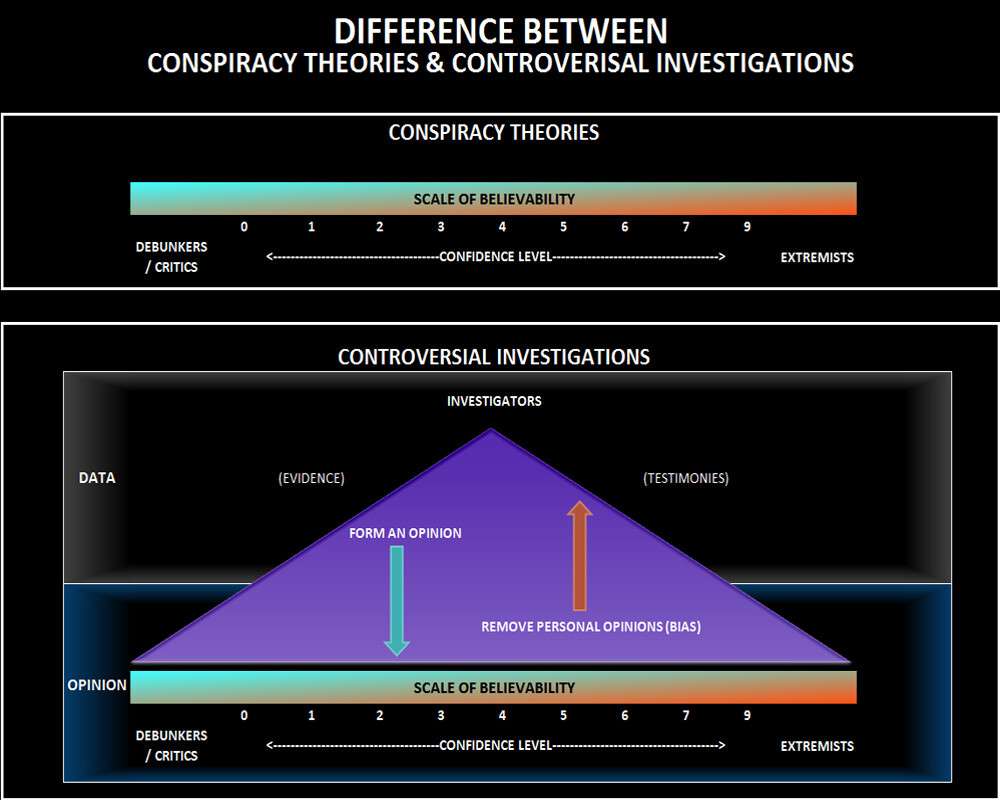
Controversial investigations differ fundamentally from conspiracy theories. They begin with a defined claim, evaluate documented evidence, consider social and ethical implications, and follow transparent methodologies that allow public review. Rather than presuming conclusions, controversial investigations prioritize source credibility, historical context, and falsifiability. Readers are encouraged to examine primary documents, assess competing explanations, and reach informed conclusions.
Investigation Methodology & Pattern Analysis
Defining Scope and Limits
Every responsible investigation begins by clearly defining its scope and limitations. This includes identifying the specific claim being examined, the timeframe involved, the relevant institutions or individuals, and what the investigation does not attempt to prove. Clear boundaries prevent speculation and reduce misinterpretation.
Explaining Methodology
Methodology describes how an investigation is conducted. This includes outlining research methods, source selection criteria, analytical tools, and standards of evaluation. Transparent methodology allows others to review, critique, or replicate findings, which is essential for credibility.
Explaining Evidence Types
Controversial investigations rely on multiple forms of evidence rather than isolated claims. These may include historical records, statistical data, scientific measurements, technical analysis, and corroborated testimony. Each evidence type is evaluated according to its strengths, limitations, and relevance.
Verification Standards
Verification ensures that evidence is authentic, accurately represented, and contextually sound. This includes source validation, cross-referencing independent materials, and confirming that data has not been altered, misquoted, or removed from its original context.
Addressing Testimony Carefully
Eyewitness testimony and personal accounts are treated as supporting evidence rather than standalone proof. Responsible investigations consider witness proximity, consistency over time, corroboration with external evidence, and potential cognitive or situational bias.
Distinguishing Facts from Interpretation
A critical distinction is made between observable facts and interpretive conclusions. Facts describe what is documented or measured, while interpretations attempt to explain meaning or causation. Ethical inquiry remains transparent about where evidence ends and inference begins.
Acknowledging Uncertainty
Not all questions can be fully resolved. Credible investigations acknowledge uncertainty, incomplete data, and competing explanations rather than forcing definitive conclusions. Recognizing uncertainty strengthens credibility rather than weakening it.
Discussing Implications Responsibly
Only after evidence has been evaluated and limitations acknowledged are broader implications discussed. These may include ethical concerns, historical significance, social impact, or theological reflection. Implications are presented cautiously and proportionally to the strength of the evidence.
Evidence Categories Used in Controversial Investigations
Evidence Strength Scale
To reduce confusion, we describe evidence using a simple strength scale. This does not decide “truth” by itself—it clarifies how well a claim is supported.
- Level 1 — Allegation: a claim without verifiable sourcing or independent corroboration.
- Level 2 — Suggestive: some documentation exists, but it is incomplete, disputed, or lacks context.
- Level 3 — Corroborated: multiple independent sources support the same core facts.
- Level 4 — Documented: primary records (official reports, filings, archives) directly support key points.
- Level 5 — Verified: documentation + independent confirmation + successful attempts to falsify have failed (within stated limits).
Note: “Level 5” does not mean “nothing could ever change.” It means the claim is strongly supported given current public evidence and clearly stated boundaries.
Historical & Archival
→
Records
Primary sources such as government records, declassified documents, legal filings, institutional archives, and contemporaneous accounts are examined for authenticity, context, and consistency.
Statistical & Quantitative
→
Data
Statistical patterns, trend analysis, and quantitative datasets are used to identify anomalies or correlations. Statistical evidence does not establish intent but can highlight areas requiring further investigation.
Scientific & Technical
→
Testing
This includes physical measurements, laboratory analysis, engineering assessments, digital forensics, and technical documentation. Emphasis is placed on reproducibility, methodological transparency, and peer review where applicable.
Eyewitness Testimony
→
Experience
Personal accounts are evaluated for reliability through corroboration, internal consistency, and alignment with external evidence. Testimony is contextualized rather than sensationalized.
Independent Verification
→
Evidence
Claims gain strength when separate investigators, unaffiliated institutions, or competing analysts reach similar conclusions using independent data sources. Independent corroboration reduces reliance on single narratives or authorities.
Ethical & Theological
→
Evaluation
From a biblical perspective, investigations are guided by principles of truthfulness, multiple witnesses, restraint, and accountability. Scripture encourages discernment without fear, speculation, or false accusation.
Conspiracy Theories
For the LORD spoke thus to me with his strong hand upon me, and warned me not to walk in the way of this people, saying: “Do not call conspiracy all that this people calls conspiracy, and do not fear what they fear, nor be in dread. But the LORD of hosts, him you shall honor as holy. Let him be your fear, and let him be your dread.
Isaiah 8.11-13
The term conspiracy theory is commonly used to describe claims involving alleged secret coordination. However, the label is often applied broadly—sometimes inaccurately—to dismiss legitimate inquiry or, conversely, to promote speculation without evidence.
For clarity, conspiracy theories are often defined as claims that lack transparent methodology, verifiable sourcing, or falsifiability. These differ fundamentally from structured investigations that rely on documentation, corroboration, and peer critique.
Conspiracy Criticism
Critical evaluation is essential to intellectual integrity. Healthy skepticism challenges assumptions, tests sources, and resists emotional manipulation. However, criticism itself can be misused—either to suppress inquiry or to shield unfounded claims from scrutiny.
Responsible investigation requires examining evidence independent of ideological pressure, institutional authority, or popular opinion. Motive alone does not determine truth; documentation and methodology do.
Conspiracy Exaggerations
Legitimate investigations are often undermined when unrelated or extreme claims are attached without evidence. Such exaggerations create confusion, weaken credibility, and allow valid concerns to be dismissed wholesale. This section deliberately separates substantiated inquiry from narrative inflation, emphasizing restraint, corroboration, and proportional conclusions.
FAQ
What is the difference between a conspiracy theory and a controversial investigation?
A controversial investigation begins with a defined claim and evaluates it using documented evidence, transparent methodology, and verification standards. A conspiracy theory often relies on speculation, unfalsifiable assumptions, or selective sourcing without clear standards for verification or correction.
What kinds of evidence are considered most credible?
Generally, the strongest evidence includes primary documents (archives, legal filings, official records), corroborated datasets, and technical findings that can be independently checked. Secondary sources can help with interpretation, but should not replace primary documentation when it is available.
How should eyewitness testimony be treated?
Testimony can be valuable but should be treated as supporting evidence rather than standalone proof. Responsible analysis considers proximity, consistency, corroboration, potential incentives, and the known limitations of memory and perception.
How do you avoid bias when evaluating controversial claims?
Bias is reduced by using clear standards: verify sources, compare competing explanations, separate facts from interpretations, and look for independent corroboration. It also helps to identify emotional triggers and avoid drawing conclusions beyond what the evidence can support.
How does biblical discernment apply without becoming sensational?
Scripture emphasizes truth, careful judgment, and multiple witnesses while warning against fear-driven thinking and false accusation. Christian discernment calls for humility, restraint, and accountability—especially when evidence is incomplete or disputed.
Ask AI About Controversial Topics & Investigated Claims
Use our AI-powered research tool to explore controversial topics through documented evidence, historical records, ethical analysis, and biblical discernment. This tool is designed to distinguish unverified conspiracy theories from structured controversial investigations by focusing on methodology, source credibility, and public documentation.
Search by topic, historical event, institution, or investigative claim to examine how evidence is evaluated, how narratives form, and how Scripture addresses discernment, truth, and deception.
Suggested questions:
- “What is the difference between a conspiracy theory and a controversial investigation?”
- “What historical examples show verified conspiracies versus unproven claims?”
- “How should Christians evaluate controversial claims ethically and biblically?”
- “What standards of evidence are used in investigative journalism and academia?”
- “How does the Bible address deception, secrecy, and truth-seeking?”
- “What psychological and sociological factors contribute to mass manipulation?”
- “How can bias distort both belief and skepticism?”
Source Transparency & Corrections
- Primary-first: when possible, we link to original documents (archives, filings, official reports) before commentary.
- Quoting rules: we avoid clipped screenshots and quote-mining; we prefer direct links and surrounding context.
- Competing explanations: we include credible alternative interpretations when they exist.
- Corrections: if a citation is wrong, outdated, or misleading in context, we update the page and note the change.
Reader note: Strong language is not a substitute for strong evidence. We aim for careful, proportionate conclusions.
References & Research
Biblical & Theological Discernment
- Bible Gateway — Multiple translations for Isaiah 8:11–13 and related passages
- Desiring God — How Christians should respond to conspiracy theories
- Ligonier Ministries — Christian theology, discernment, and ethics
Philosophy, Epistemology & Critical Thinking
- Stanford Encyclopedia of Philosophy — Epistemology and evidence evaluation
- Stanford Encyclopedia of Philosophy — Critical thinking principles
- Internet Encyclopedia of Philosophy — Truth, justification, and knowledge
Investigative Journalism & Evidence Standards
- Columbia Journalism Review — Investigative reporting standards
- ProPublica — Public-interest investigative journalism
- Society of Professional Journalists — Code of ethics
Government, History & Public Records
- U.S. National Archives — Declassified records and FOIA documents
- CIA FOIA Reading Room — Publicly released intelligence documents
- UK National Archives — Historical government records
Psychology, Sociology & Mass Influence
- American Psychological Association — Cognitive bias and belief formation
- Encyclopaedia Britannica — Propaganda, social influence, and group psychology
- National Institutes of Health — Behavioral and cognitive science research
Media Literacy & Misinformation
- MIT Media Lab — Misinformation and media research
- Poynter Institute — Fact-checking and media literacy
- Snopes — Claim verification (use critically)