

Creation Science & Evolution – Intelligent Design – The Creation Model
Table of Contents
Overview – Creation Models
Intelligent Design and Creation Models are scientific frameworks that propose created or designed entities originate and function based on the intricate complexities and specific purposes established by an intelligent designer or creator. These models assert that such design inherently points to the existence of an Intelligent Designer.
Therefore, design demands a designer.
Intelligent Design proponents generally adopt a neutral stance toward specific religious beliefs, basing their conclusions solely on empirical scientific evidence. In contrast, creationists typically approach the topic from a worldview beginning with the Bible.
This is why studying a biblical creation model is important. As we delve deeper into the study of design and creation, the evidence within it reveals a Creator who is an intelligent and emotional being, transcending all known principles and natural laws—perfectly aligning with the descriptions found in the Bible. However, the design components presented in the Creation model below will support either worldview.
Biblical Creation Model
The Biblical Creation Model emphasizes that scientific evidence not only supports the notion of intentional design in creation but also identifies the God of the Bible as the Designer.
To understand this, we can examine how everything in existence, from the microscopic realm to the vast universe, functions together in a harmonious and interconnected way. In this context, the Biblical Creation Model provides a comprehensive explanation for the entire observable universe.
When we analyze the physical universe, we see that it operates according to fundamental principles such as the laws of physics, logic, and mathematics. Physics governs the motion of waves, the behavior of matter, and the existence of space—providing a framework within which material things manifest and interact.
Every system integrates and collaborates to build an increasingly complex, more sophisticated system!
Each system has – Intent – Purpose – Design – Complexity
Creation Model – Sub-System Hierarchy
The First and perhaps longest concept in the Creation Model is the subsystem (component) hierarchy.
Within this framework, complex systems are composed of smaller subsystems that work collaboratively. These systems exist in hierarchical structures, where each level contributes to the formation and function of higher levels. For example, microscopic particles combine to form molecules, molecules form cells, cells form organisms, and so on, all the way to the cosmic hierarchy of galaxies. Each uniquely designed structure operates in perfect harmony with the others.
On a microscopic level, we observe evidence of intelligent design concerning how every component interacts seamlessly. These small systems work together to form larger systems, which themselves integrate into even more complex and expansive systems. This interconnectedness extends upward from atoms and molecules to the complexity of galaxies, showcasing an intricate and harmonious design at every level.
As we explore the hierarchy of subsystems, keep in mind the overarching principle: the entire universe is one vast, interconnected system composed of countless smaller subsystems. Each layer of creation builds upon the previous one, forming larger and more complex systems that work together in perfect unity. Each system is simply a larger more complex collaboration of smaller units communally working together to create a new unique structure and system, following a new unique function (purpose). This intricate design reflects a purposeful and intelligent Creator and the use of information.
Once you review the entire model below, take a moment to reflect on the entire system — from the intricate micro-universe and the mathematical principles of physics to the vast astronomical functions. Consider how all these elements seamlessly work together within a harmonious, balanced system. This overarching framework is what we refer to as the Creation Model.
Mathematics, Quantum Laws

Never take for granted the remarkable fact that mathematics works! This fact only makes sense if the universe was designed based on principles of logic. Mathematics embodies the fundamental laws that must remain consistent for reality to hold together. It is a precise and logical framework, meticulously designed to sustain the functionality of creation. This consistency allows each level of structure to build seamlessly upon the next, ensuring the harmonious operation of the entire universe.
Everything we perceive in the universe can be reduced to its most fundamental properties based on the laws of mathematics, which universally maintain proportionality across all functions and formulas. These principles ensure a perpetual balance, beginning from a 0-dimensional point, forming the building blocks, expanding outwards, governing every aspect of creation with precision and harmony.
reality demonstrates that everything operates, not by random chance, but through intricate design, as evidenced by mathematical formulas.
Quantum Spatial Dimension

From mathematical concepts emerge theories about the micro-universe, an unseen realm that forms the foundation of the observable world (Hebrews 1:3).
Inductive Spatial Dimensions
To understand spatial dimensions, consider a single point in space, representing a zero-dimensional object. When this point is extended in a new direction, it becomes a one-dimensional line. Moving that line in another direction and curling it back on itself creates a two-dimensional object. Each time a dimension is extended in a new direction, it adds another degree of dimensionality, expressed as n+1. These concepts are demonstrated in quantum string theory.
Quantum Strings
Quantum strings are theoretical sub-particles that form the foundation of all matter in the universe. The physical laws governing space allow for vibrations within the framework of motion, producing one- and two-dimensional structures known as quantum mechanical strings. These strings exist in dimensions beyond the visible three-dimensional world, forming the building blocks of subatomic particles.
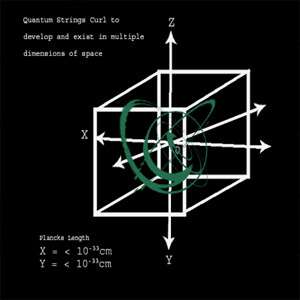
Quantum Strong Vibrations
Quantum strings vibrate across multiple dimensions, enabling the construction of particles within the three-dimensional spatial and material world. These vibrations act as the bridge between the unseen quantum realm and the observable universe, underpinning the intricate structure of creation.
Sub-Atomic Particles
Theoretical strings, when curled up, give rise to subatomic particles within our universe. Subatomic particles represent the smallest physical components currently observable, including quarks and electrons, which serve as the fundamental building blocks of all atoms in the physical universe.

According to the laws of physics, the strong nuclear force ensures the stability of these sub-particles, enabling them to exist independently or bond together to form new particles at the atomic scale.
Atomic Particles

As subatomic particles combine to form atoms, a new intricately designed system emerges. Atoms serve as the building blocks for all molecules in the universe, enabling an incredible variety of combinations governed by the laws of chemistry.
When atoms bond, they create molecules—clusters of atoms arranged into unique structures. These molecules are the foundational components of every physical object in existence.
From rock formations and amino acids to water and the atmosphere, these diverse structures showcase the vast potential of molecular design, forming the essential elements of the physical universe.
Molecules

Molecules are clusters of atoms bonded together in specific structural patterns. These molecules can further combine to form inorganic structures or assemble into highly specialized, programmable codes within organisms, giving rise to complex systems such as organs and tissues.
Molecular Structures

Molecules can join together in chains to form inorganic structures or assemble into programmed sequences to create organic structures. It is at this stage that the distinction between organic and inorganic matter becomes apparent.
Molecular arrangements that encode information give rise to organic compounds, such as amino acids, which are the building blocks of proteins. In contrast, other molecular formations—resulting from large aggregations or clusters of molecules—create inorganic structures and compositions.
Organelles & Inorganic Compounds
Biochemical Compounds

Molecules collaborate to form organelles, the functional “organs” of a cell. These organelles are intricate organic structures, composed of precisely encoded molecular chains designed to produce the remarkable complexity observed in biology. These molecular chains act as building blocks, assembling into highly sophisticated factories responsible for some of the most advanced functions in the universe.
Under a microscope, cells reveal themselves as bustling, factory-like systems. Each cell operates like a high-traffic city, with specialized areas dedicated to production, transportation, and regulation, all working together to sustain the cell’s functions and ensure its survival.
On a larger scale, organs function in harmony to form a complete body, a complex system capable of remarkable functionality. This system not only sustains the organism but also defines its unique identity as a cohesive, working unit.
Proteins and acids, the foundation of organic life, are composed of molecular structures that are meticulously programmed in specific sequences to form the basic building blocks of all living organisms.

Organic Basic Structure
Cells and Cellular Structures
Organelles collaborate seamlessly to drive the advanced complexity and functionality of the cell.
Constructed from vast quantities of organic compounds and intricate structural support systems, the cell is a marvel of design—processing and managing more information than all the factories in the world combined.

Organic Masses
Organs and Organic Structures
Cells are the fundamental building blocks of all living organisms. They work in harmony and communicate with one another to form organs, which are essential components of the complex systems that sustain living bodies.
Organic Bodies
Organic systems operate in intricate harmony, working together as balanced components to form the entirety of a living organism.

The design of a fully functioning body relies on the seamless integration of multiple high-performance systems, each contributing to its overall functionality and vitality.
Ecology – Organic Communities, Cycles and Socio-interactions
Biological Interactions

Functioning bodies then work together to create communities that in turn work together to function as a balanced system for the benefit and survival of the entire organic ecology. Everything must work together with inorganic structures to make a habitable and living environment for all organisms.
Nothing can overpopulates and overtake other communities, nothing can cause mass destruction, famine, or plague or else organisms would not be able to persist.
Everything must be designed to continually work together on a massive scale to function and play their part in a working society.
Inorganic Compounds
Returning to the structures of inorganic compounds formed by molecules: much like organic structures that are essential for life, inorganic formations also play crucial roles in the environment and the broader ecosystem. For example, ice forms as a storage unit atop mountains, acting as a reservoir that supports life by gradually releasing water into surrounding systems.

Inorganic bodies, such as water, combine with other elements to form a wide variety of structures, including rocks, minerals, and other natural formations. These elements clump together or bond in unique ways, creating the foundational materials that shape and sustain the physical world.
Inorganic Bodies
Inorganic structures work together (inorganic minerals make up the mountains, ice, water) and combined in large quantities to create entire local ecological systems –

For example the atmosphere is the combination of multiple layers of inorganic gases in large quantities, mountains are the accumulation of a large system of inorganic minerals compiled together, oceans are the assimilation of large quantities of bodies of water etc. throughout the entire world.
Ecology ‘Inorganic’ Systems
Inorganic systems operate and interact based on both complex processes that involve many different interacting systems and fundamental laws of physics, forming vast ecosystems and ecological cycles that are essential for the survival of organic life. These intricate networks are critical for sustaining life and ensuring the continuity of its processes.

What is truly remarkable is how the same physical principles that govern interactions at microscopic scales also enable the functioning and integration of these complex, larger systems. This seamless interplay across scales highlights the extraordinary design and interconnectedness of all creation.
Ecological Organic and Inorganic Systems

The interplay between organic and inorganic systems creates complete environments that are essential for the functionality and sustainability of life. Organic systems, such as plants, animals, and microorganisms, interact intricately with inorganic elements like water, minerals, and atmospheric gases to form ecosystems. These ecosystems serve as the foundation for life, enabling complex networks of interdependence and resource exchange.
On an even larger scale, these ecosystems are deeply integrated with planetary and astronomical systems. Features such as the solar system’s dynamics, the Earth’s rotation and tilt, and gravitational forces drive global phenomena like seasons, tides, and climate patterns. The sun provides the energy that fuels photosynthesis and maintains the delicate thermal balance required for life. Meanwhile, the moon influences tidal movements that regulate coastal ecosystems and play a role in nutrient distribution.
This interconnected web, from the microscopic to the astronomical, showcases a harmonious design in which every component—from molecules to planetary systems—plays a vital role. Together, these organic and inorganic interactions create a finely tuned environment where life not only exists but thrives.
Global Ecology
Ecological systems work together to form a cohesive planetary system that supports all life within it, creating the interconnected world we inhabit. The entire planet functions as a unified whole, integrating its diverse inhabitants with the fundamental laws of physics operating on a grand scale. These laws maintain the balance of elements and processes essential for Earth’s perpetual existence and the continuation of life.

For life to thrive, every aspect of the planet must be carefully designed to function in harmony. This intricate balance ensures that ecosystems, climates, and resources remain stable, allowing the planet to sustain and support the diverse forms of life it holds.
Laws of Relativity
Somehow, ‘miraculously,’ physics seem to work well not only to regulate the micro (quantum) universe but is perfectly designed for regulating everything in the cosmic universe as well. Keeping planets, star systems, and everything balanced in the cosmos.
Solar System
Gravitational relationships, the distances between stars and planets, the radiation of starlight, and the specific type of star all play a critical role in creating a habitable environment. Factors such as temperatures, magnetic field shielding, the vast low-density expanse of space, and the proper positioning of gas giants within the system further contribute to this delicate balance.
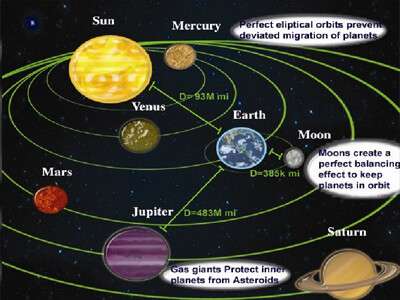
For example, gas giants remain in stable outer orbits and do not migrate into the inner system, preserving the conditions necessary for habitable planets. The circular orbits of planets, the minimal deviation of habitable planets, and the gravitational relationship between moons and their planets all work together to maintain the perfect equilibrium required for life. These relationships prevent destabilizing forces, such as gravitational disruptions from outer gas giants, from pulling the habitable planet out of its delicate balance.
The precise mathematical balance governing these systems is vital and must be intentionally designed with purpose. Such a finely tuned arrangement could not occur without an underlying design to set these conditions into motion.
Galaxies

Astronomical Communities
Star systems, galactic materials, stars, and radiation levels must work in harmony to maintain the balance of the astronomical bodies within their respective systems. These features interact seamlessly with the fundamental laws of physics—such as gravity—to regulate the motion of celestial objects, drive the dynamics of the galaxy, and create the conditions necessary for the passage of time and the existence of life.
The location of our solar system within the Milky Way is particularly significant. Positioned at a safe distance from the galactic center, it avoids intense radiation and molecular clouds, allowing stable conditions to persist. Gravity plays a crucial role in maintaining this delicate equilibrium, ensuring the stability of planetary orbits and shielding the system from destabilizing forces.
These higher-order systems, from planetary structures to galactic dynamics, appear to be finely tuned to sustain the balance necessary for organic life on a much smaller scale. The interconnectedness of these vast systems highlights the precision and complexity required to support life as we know it.
Evidence for the Creator
In this model we empirically observe that each system works to create a new hierarchy of complex design that not only harmonizes but compensates other systems, working to create a perfectly orchestrated whole of creation.
For example atoms, as the fundamental components of matter, harmonize within their own systems to create stable structures. These atoms not only sustain their individual systems but also combine to form a higher-level framework—molecular structures. In turn, these molecular structures follow a similar pattern, collaborating to build yet another “step up” in complexity, serving as the foundational building blocks for even larger and more intricate systems. This progression demonstrates a consistent and purposeful design, with each level contributing to the creation of something greater.
This extraordinary precision goes beyond chance or random occurrence. The fact that the location, composition, and dynamics of the solar system are perfectly aligned to support organic life strongly points to the existence of an intelligent Creator. The intricate fine-tuning observed at every level—from planetary orbits to galactic placement—demonstrates purposeful design. It is not merely a matter of physics functioning autonomously, but evidence of a deliberate, intelligent force ensuring that life can exist and thrive in a universe that works in perfect harmony.
Answering Criticism on the Creation Model
It is argued that by simply looking at a system, it should just simply work given the fact there are multiple interactions in that system, and that it will be able to work itself out in time.
Not only does this argument go against logic, but looking at the continual “BIGGER PICTURE” on each level and in every system, everything continues ‘stepping up’ to makes a more intricate system.
Darwinian Evolution, or the belief that absolute random chance created all things, is not even feasible when you observe everything in one large picture, because the problem isn’t just with biology anymore. The problem is with everything from quantum physics to the cosmic universe working together in a designed order to create overall perfect systems of balance order and glory.
The fact that everything even works at all is the astonishing fact, let alone that everything works on its own level to create a larger more intricate body or system. Each level of complexity shows design and intent, and everything is a masterpiece of design by our creator as shown in every piece of His creation.
The Anthropic Principle
A very interesting observation taking in account all the evidence in the creation model in reference to the physical universe; is that beginning on a micro scale and moving up to the organic level, then taking everything from the galactic-cosmic level and moving back down to the organic level.
We find that everything seems to be designed in the creation model to be a supportive for the existence of organic life on every level. The fact that each level and system of functionality works to be a sustentation for organic life seems to be another piece of compelling evidence towards the Anthropic Principle, namely, that the universe was created as a dwelling place for mankind, the only self-aware being that can look up to the creator in this material universe.
Who hath measured the waters in the hollow of his hand, and meted out heaven with the span, and comprehended the dust of the earth in a measure, and weighed the mountains in scales, and the hills in a balance?
Isaiah 40.12
God measured all the properties of all the elements on earth in exact proportion to assure that everything would remain in balance. He measured just the right amount of air, water, hydrogen etc. putting them all in just the right place for his perfect creation. He is the Powerful Designer, Creator of everything in the beginning and He purposed everything exactly where He put it with exactly how much He intended it to have, with a perfect balance.
References – Creation Model
Answers in Genesis – Biblical Creation Model
Answers in Genesis – Does the Biblical Creation Model Make Predictions
Reasons to Believe – Approach to the Creation Model
Design of the Solar System’s Gas Giants – Reasons to Believe
The Heavens Resound with a Message for Mankind – Reasons to Believe
Leave a Reply
You must be logged in to post a comment.