

Evolution – Biology – Microbiology and Genetics
Table of Contents
Overview: Microbiology and Genetics
Microbiology and genetics examine life at its most fundamental level—cells, genetic information, and the molecular systems that sustain all living organisms. Far from being simple or primitive, even a single living cell is an information-rich, highly coordinated system capable of self-regulation, repair, reproduction, and energy management. Modern microscopy and molecular biology have revealed a level of complexity that was entirely unknown in Darwin’s time.
Evolutionary theory proposes that such systems arose through gradual, unguided processes—random genetic changes filtered by natural selection over long periods of time. However, this raises critical questions. Complex cellular systems depend on tightly integrated components that must exist simultaneously to function. Partial or nonfunctional intermediates would confer no survival advantage, making stepwise construction through random processes biologically implausible.
Genetics deepens this challenge. DNA functions as a coded information system, comparable to written language or computer programs. Information must already exist before it can be copied, modified, or selected. While genetic variation and adaptation are well documented, these processes operate within the limits of existing genetic information and do not demonstrate the origin of new, fully integrated biological systems. This section examines microbiology and genetics through a critical lens:
- The complexity of cellular structures
- The limits of gradual adaptation
- The origin of biological information
- Genetic variation versus macroevolution
- Genetic similarity and homology
- Claims surrounding “junk” DNA
Together, these observations are evaluated to determine whether the evidence supports unguided evolutionary origins or points instead toward intentional design and pre-programmed biological systems.
Microbiology and Genetics Often Taught Together
Microbiology and genetics are often taught together because they examine the same biological reality from complementary angles. Microbiology studies the physical and biochemical machinery of life at the cellular level, while genetics studies the informational system that directs and regulates that machinery. Cells cannot function without genetic instructions, and genetic information has no meaning apart from the cellular systems that read, interpret, and execute it. Together, they form a unified framework for understanding how life operates at its most fundamental level—structure and information acting in coordination.
“If it could be demonstrated that any complex organ existed, which could not possibly have been formed by numerous, successive, slight modifications, my theory would absolutely break down.” — Charles Darwin, On the Origin of Species
Cellular Microbiology

Cellular microbiology is the bridge between cellular biology and microbiology. Cellular biology is the study of cells and their physiological properties. In Charles Darwin’s time, the internal structure and molecular organization of cells were largely unknown. Cells could be observed only at low resolution, and their complex internal systems had not yet been discovered.
Today, Microbiologists can magnify and examine living cells to identify just how complex they truly are! Even a single living cell exhibits levels of coordination and efficiency that rival—and in many ways exceed—those of the most sophisticated human-engineered systems. Let’s consider what they can do:
- self-diagnose
- self-repair
- perform coordinated biochemical tasks
- reproduce
- grow and regulate internal conditions
The nucleus of the cell contains the chromosomes, which store the genetic information required to build, regulate, and maintain cellular function. The nucleus is literally more advanced, comparatively, than any supercomputer in the world today.
Video: Processes and Various Functions of Cellular Life
A Most Complex Factory
A useful analogy for understanding cellular complexity is that of a factory. Modern factories rely on external designers, centralized control systems, specialized machinery, energy input, logistics, and maintenance personnel. By contrast, a living cell contains all of these functions internally. It processes and stores vast amounts of information, regulates energy production, coordinates molecular logistics, repairs its own components, and—most strikingly—can reproduce an entire working copy of itself. No human-engineered factory today possesses the capacity for fully autonomous self-replication while simultaneously maintaining, regulating, and executing its own production systems. The technological sophistication required to accomplish this exceeds anything currently achieved by human industry.
Gradual Adaptations
Evolutionary theory proposes that biological complexity arises through gradual adaptations—small, incremental genetic changes accumulating over long periods of time. These changes are presumed to be filtered by natural selection, such that beneficial variations are preserved while non-beneficial ones are eliminated. While this model may appear plausible at a superficial level, it encounters serious difficulties when applied to complex biological systems, particularly at the cellular level.
All-or-Nothing Structures
Gradual adaptation assumes that intermediate stages of development can provide functional advantages. However, many biological systems require multiple components to be present and functional simultaneously in order to work at all. If a system depends on several interacting parts, the absence or malfunction of even one component renders the entire system ineffective. In such cases, partial or incomplete versions offer no survival benefit and therefore cannot be meaningfully selected for.
At the cellular level, this presents a fundamental challenge. Cellular systems are not isolated components but tightly integrated networks. For example, genetic regulation, energy production, protein synthesis, and waste management are all interdependent. A nonfunctional intermediate does not merely perform poorly—it fails outright.
Simultaneous Progression
A clear illustration of this problem is the relationship between the nucleus and the mitochondria in eukaryotic cells. The nucleus contains the genetic information necessary to regulate cellular processes, while mitochondria generate the energy required for those processes to occur. Neither system is useful in isolation. A nucleus without energy production cannot function, and energy production without genetic regulation is equally futile.
While evolutionary models propose various hypothetical pathways to address this interdependence, the underlying issue remains: for a cell to survive, both systems must already be present and operational. Gradual, stepwise construction through nonfunctional intermediates offers no clear mechanism for achieving this level of coordination.
“There are no known eukaryotes without mitochondria, or remnants of mitochondria.” — Nick Lane, Power, Sex, Suicide: Mitochondria and the Meaning of Life (Oxford University Press, 2005)
Biochemist Nick Lane of University College London argues that the energetic demands of eukaryotic complexity cannot be met without mitochondria already in place, making mitochondrial function a prerequisite rather than a late evolutionary addition.
Limits of Gradualness
Gradual adaptation also faces a second problem: the nature of random variation. Random genetic changes are non-specific. They do not target future functionality but generate a wide range of outcomes, most of which are neutral or harmful. If complex cellular systems arose through such processes, biology should be filled with vast numbers of nonfunctional or partially functional cellular structures—failed experiments preserved alongside successful ones.
Yet this is not what we observe. Cells are remarkably efficient, streamlined, and integrated. Cellular components work together with precision, and unnecessary or dysfunctional structures are not found accumulating within living systems. The absence of widespread biological clutter stands in stark contrast to what a trial-and-error process would predict.
Irreversible and Irreducible Complexity
This problem is often described in terms of irreducible complexity, defined as a system composed of multiple interacting parts that contribute to a specific function, where the removal of any one part causes the system to cease functioning effectively. Such systems cannot be built gradually if intermediate stages provide no functional advantage.
When applied to cellular biology and genetics, this principle directly challenges the plausibility of gradual evolutionary construction. Systems that require coordinated, simultaneous functionality cannot be assembled through incremental, unguided steps without rendering the organism nonviable.
Does Complexity Support Unguided Evolution?
It is sometimes argued that extreme complexity itself supports evolution—that given enough time, random processes can produce any outcome. However, probability works in the opposite direction. As complexity increases, the likelihood of unguided assembly decreases. Highly complex systems require precise coordination, correct sequencing, and functional integration across multiple components.
An increase in complexity does not make random assembly more plausible; it makes it less so. While simple systems may tolerate limited variation, complex systems demand informational precision. At the cellular level, this precision is not optional—it is essential for survival.
Evolution and Abiogenesis: Origin of Cells
A critical distinction must be made between biological evolution and the origin of life. Evolutionary theory addresses how living organisms might change over time once life already exists. It does not, by itself, explain how the first living cell originated. The question of how non-living chemistry produced the first self-replicating, information-bearing cell is a separate problem known as abiogenesis.
Despite this distinction, discussions of evolution often assume that the origin of the first cell can be accounted for by natural processes operating without guidance. This assumption deserves careful examination, particularly in light of what modern microbiology and genetics reveal about cellular complexity.
Organic Evolution – Random Acquisitions
Evolutionary models of abiogenesis propose that random chemical interactions, occurring under favorable conditions, eventually produced the molecules necessary for life. These molecules are presumed to have self-organized into functional genetic information systems capable of replication and metabolism.
However, this proposal faces a fundamental problem: information does not arise simply from complexity or repetition. Genetic information is not merely chemistry—it is organized, sequential, and functional. Random processes can generate patterns, but patterns alone do not constitute meaningful information capable of directing biological systems.
A common analogy helps illustrate the difficulty. Randomly producing letters—whether by typing, scattering ink, or mechanical processes—does not naturally result in coherent language, meaningful instruction, or executable programs. Likewise, randomly assembling molecules does not inherently produce the precise, information-rich sequences required for DNA to function as a biological code.
The Information Content of the Cell
The scale of information contained within even a single human cell highlights the challenge facing abiogenesis. The chromosomes of one human, if transcribed into written form, would require an amount of text so vast that it would fill enormous physical space. Carl Sagan famously noted that the genetic information contained in a single human being would fill the Grand Canyon dozens of times over.
Estimates of the information content in human DNA illustrate its extraordinary scale. Carl Sagan noted that if the genetic information contained in a single human were translated into written language, it would require an immense number of volumes—an amount often illustrated by comparisons such as filling the Grand Canyon many times over. While this analogy is illustrative rather than a literal measurement, it underscores the vast quantity and organization of information encoded within human chromosomes. — Carl Sagan, The Dragons of Eden, p. 25; see also Walt Brown, In the Beginning, p. 62
This is not merely a question of quantity but of organization. The information stored in DNA must be arranged in exact sequences, interpreted by molecular machinery, and executed within a tightly regulated cellular environment. Without preexisting systems capable of reading and acting upon that information, the code itself is meaningless.
Probability and Biological Organization
When probability is applied to the formation of functional biological systems, the challenge becomes more severe. Random chemical interactions do not aim toward future functionality. They generate vast numbers of ineffective combinations alongside rare functional ones. Yet living cells do not exhibit signs of such trial-and-error accumulation. Instead, they display tightly integrated systems operating with high efficiency and minimal redundancy.
If life arose through unguided random processes, we would expect to find extensive evidence of failed or partially functional biochemical systems preserved within living organisms. Instead, cellular systems appear purpose-built, coordinated, and dependent on preexisting informational frameworks.
Abiogenesis as an Unresolved Problem
Despite decades of research, abiogenesis remains an unsolved problem in biology. No experimental model has demonstrated how non-living chemistry can generate a fully functional, self-replicating cell containing encoded information, regulatory mechanisms, and metabolic systems. While hypotheses exist, they remain speculative and incomplete.
This unresolved gap is significant. Without a viable explanation for the origin of the first cell and its information systems, evolutionary models lack a foundational starting point. The complexity uncovered by microbiology and genetics does not simplify the problem—it magnifies it.
Given the informational precision, coordinated complexity, and functional integration required for living cells to exist, such systems are most reasonably explained by an intelligent cause rather than unguided processes. Only an intelligent designer adequately accounts for complexity operating at this level of precision.
Genetics
Genetics is the study of how biological information is stored, transmitted, and expressed within living organisms. At its core, genetics deals not merely with chemistry, but with information—coded instructions that govern the construction, regulation, and maintenance of life. These instructions are precise, ordered, and functionally specific.
How Do Genetics Work?
Genes can be understood as functional units of information, comparable to words in a language or commands in a computer program. Individually, genes encode instructions for specific proteins; collectively, they form a coordinated system that directs biological development and function. Proteins and cellular machinery read and execute this information, using it as a blueprint to build and regulate biological structures. At the most basic level, genetic organization follows a clear hierarchy:
- Molecules combine to form nucleotides
- Nucleotides are arranged into genes
- Genes are sequenced to form DNA
- DNA is packaged with proteins into chromosomes
- Chromosomes are stored, regulated, and replicated within cells
This structure is not random. Each level depends on correct sequencing and precise organization to function.
Chromosomes, DNA, and Genes

Chromosomes are highly organized molecular structures composed of DNA (Deoxyribonucleic Acid) and associated proteins. They contain not only genes but also regulatory elements that control when, where, and how genetic information is expressed. DNA itself is a nucleic acid that stores genetic instructions using a four-letter chemical alphabet, arranged in exact sequences ( A – T – C – G ).
Genes are specific segments of DNA that encode instructions for building proteins. Proteins, in turn, perform the vast majority of cellular functions, from structural support to enzymatic activity. The relationship between genes, proteins, and cellular function is direct and tightly regulated. Any disruption in sequencing or expression can lead to dysfunction or disease.
Human DNA and Informational Density
Human DNA represents one of the most information-dense systems known. Although the total DNA from all the cells in a human body would fit into a very small physical volume, the information it contains is immense. When expressed symbolically—as written language or code—it represents billions of precisely ordered units of information.
“The average human has over 50 trillion cells; the total DNA from these cells would only fill about two tablespoons. If all the chromosomes from one person were stretched out and laid end to end, it could go from the Earth to the Moon hundreds of thousands of times.” — Walter Brown, In the Beginning, p. 62 (illustrative compression analogy)
This informational density is not merely quantitative but qualitative. DNA sequences must be interpreted correctly by cellular machinery, coordinated across tissues, and regulated in response to environmental and developmental conditions. The system functions only because the information is already structured, meaningful, and executable.
Genetic Information and Its Limits
Genetic variation is well documented. Genes can be duplicated, deleted, rearranged, or altered through mutations. These processes can produce variation within organisms and populations. However, such changes operate on preexisting information. They modify, copy, or degrade what already exists; they do not explain the origin of entirely new, integrated information systems.
Random changes to genetic code tend to disrupt function rather than create new coordinated systems. Beneficial variations are rare and limited in scope, while most random alterations are neutral or harmful. This distinction is critical: variation within a system does not explain the origin of the system itself.
Genetics and Intelligent Causation
The structure of genetic information closely parallels other known information systems. In every observed case—languages, codes, software, symbolic communication—information arises from intelligence, not from undirected processes. The genetic code exhibits the same properties: symbolic representation, sequencing, error correction, and functional execution.
Given the precision, integration, and informational depth required for genetic systems to function, the most coherent explanation is intelligent causation rather than unguided natural processes. Genetic variation and adaptation are real, but they operate within boundaries established by preexisting information. The origin of that information points beyond chemistry alone to intentional design.
Programming the Genetic Code
“Whenever we find information—especially information-rich systems—arising from material processes, we invariably trace that information back to an intelligent source.” — Stephen C. Meyer, Signature in the Cell (2009) [This conclusion aligns with information theory, where meaningful codes are known to originate from intelligence rather than unguided physical processes.]
Genetic information functions as a programmed system. It does not merely exist as chemical matter but operates as encoded instructions that must be correctly sequenced, interpreted, and executed for life to function. Information of this kind cannot arise from chemistry alone; it must already be encoded before it can be copied, modified, or regulated.
DNA uses a four-character chemical alphabet to store instructions, but the critical factor is not the chemistry itself—it is the order of the sequence. Just as letters must be arranged correctly to form meaningful words, genetic sequences must be arranged with precision to produce functional biological outcomes. Any significant deviation from the correct sequence typically results in malfunction or failure.
Video: Evolution or Genetic Variations
Understanding How Programs Work
In every known information system—written language, computer software, digital communication—the function depends on correct sequencing and interpretation. Information must be arranged in a specific order and processed by a system capable of reading it. Random changes to symbols or code do not produce new functionality; they disrupt it.
Modern computing provides a useful parallel. A program is not defined merely by the presence of symbols, but by their arrangement and execution within a system designed to interpret them. If instructions are out of order, missing, or corrupted, the program fails.
The same principle applies to genetic information: cellular instructions must be highly specific, correctly sequenced, and accurately interpreted by molecular machinery in order to produce viable structures and sustain life. Given the interdependent complexity of these processes, even small deviations can result in nonfunctional or catastrophic outcomes, underscoring the extraordinary precision required for cellular systems to operate at all.
Different Types of Programming
Information can be encoded in several ways:
Written language

This method encodes meaning through ordered symbols that require a shared language to interpret.
Digital data

This method encodes information using binary sequences processed by hardware designed to execute instructions.
Genetic information

This method encodes biological instructions chemically, using nucleotide sequences that are read, translated, and executed by molecular machines within the cell.
Among these, genetic encoding is the most compact and sophisticated. Using only four nucleotides, DNA stores vast amounts of functional information that governs development, repair, regulation, and reproduction. This information must be exact; even small errors can have severe consequences.
Changes to the Code
Evolutionary models propose that genetic information changes through random variation. In practice, only a limited number of mechanisms can alter genetic sequences:
- Mutations that scramble or alter existing information
- Duplications that copy existing sequences
- Recombination that rearranges existing information
- Introduction of information from external sources
Each of these mechanisms operates on information that already exists. None explains how entirely new, coherent, functionally integrated information systems originate. Random changes overwhelmingly degrade information rather than generate new programming with coordinated purpose.
Example of Genetic Re-Programming
To illustrate this limitation, consider a word composed of letters. Randomly mutating, duplicating, rearranging, or inserting letters may produce variations, but it does not reliably generate new meaningful words or instructions. Most outcomes are nonsensical or destructive to the original meaning.
In this example, we will use the word: CHRISTMAS (for a program about holidays)
Mutation
Definition: part of the information gets scrambled, mutated, or damaged.
ChIRSTMAS
Result: H lost a piece (upper right-hand part), and the R and I got switched.
Duplication
Definition: part of the word gets duplicated.
CHRISTMAMAS
Result: now the word MAMA is in it.
Recombination
Definition: part of the word gets cut, scrambled, and put somewhere else.
SAMSRICH
Result: now the word spells SAMS RICH (or interpreted: Sam is rich).
Foreign Introduction
Definition: foreign information gets introduced (genetic engineering).
CHRIXYZSTMAS
Result: Randomly, new information got introduced into some part of the code.
Information, Meaning, and Legibility
Modern computing provides a useful parallel. A program is not defined merely by the presence of symbols, but by whether those symbols form legible instructions within an existing interpretive system. Randomly adding or rearranging characters does not create new functionality; it almost always produces unreadable or destructive code.
The same principle applies to genetic information. New DNA sequences must not only exist, but must be meaningful—correctly sequenced, compatible with existing regulatory architecture, and interpretable by cellular machinery. Without this framework, new sequences are biologically silent or harmful.
Thus, the core difficulty is not producing new genetic “letters,” but producing new instructions that are intelligible, executable, and beneficial within a tightly integrated system. In the example above, rearranging CHRISTMAS into “SAMS RICH” does not generate a functional instruction when the required output must still refer to a holiday. Rearrangement without contextual meaning produces noise, not information.
The same principle applies to the genetic code. Alterations can modify existing structures or produce limited variation, but they do not explain the origin of new, highly specified biological systems. Functional genetic programming requires foresight, coordination, and intentional sequencing.
Implications for Biological Origins
Genetic engineering provides a revealing contrast. When scientists modify the genetic code successfully, it is not done randomly. It requires careful planning, precise targeting, and detailed knowledge of how the system functions. This demonstrates that meaningful genetic changes arise from intelligence, not chance.
Given the complexity, specificity, and execution of genetic programming, the origin of the genetic code is best explained by an intelligent cause rather than unguided processes. Genetic variation occurs, but it operates within preexisting informational boundaries. The existence of those boundaries points beyond chemistry alone to intentional design.
Genetic Variations
Genetic variation demonstrates how living organisms express diversity without generating new biological programs. An organism’s genetic information is passed from parents to offspring, and that information contains a wide range of built-in possibilities for variation, adaptation, and expression. These variations arise not from the creation of new genetic instructions but from the recombination and expression of existing genetic information.
Inherited Traits and Genetic Expression
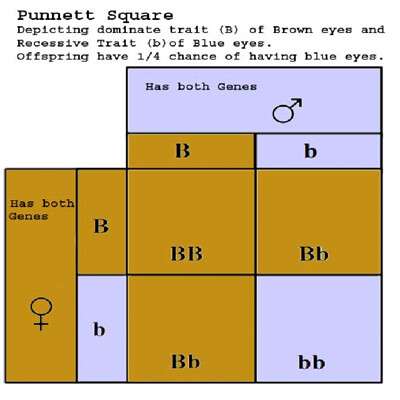
Punnett squares illustrate how dominant and recessive genes interact during reproduction to determine observable traits in offspring. These inheritance patterns show how genetic information already present in the parents is redistributed and expressed in different combinations.
For example, if both parents carry genes for brown and blue eye color, classical inheritance predicts that approximately one-quarter of their children will express blue eyes (the recessive trait), while the remaining three-quarters will express brown eyes. Of those with brown eyes, many will still carry the recessive blue-eye gene and may pass it on to the next generation. In some cases, the recessive gene may be lost entirely, but no new genetic information is created in the process.
This process determines not only which traits are expressed during development in the womb, but also which genetic options remain available for future generations.
Genetic and Natural Selection — Not Macro-Evolution
Selective breeding or natural selection can reduce or amplify certain traits within a population, but this does not constitute macroevolution. Selecting for or against existing traits merely shifts which pre-existing genetic options are expressed. It does not generate new genes, new instructions, or new biological systems.
This is best described as microvariation—the sorting, expression, and limitation of information already present in the genetic code. Such variation allows organisms to adapt to environmental conditions within defined boundaries. For example, differences in eye color or visual sensitivity reflect adaptive variation, not evolutionary innovation.
The Scale of Variation
The scale of human genetic variation is enormous. Scientists have calculated that a couple would need to have on the order of 10²⁰¹⁷ children before producing two individuals who are genetically identical in all traits—a number so vast it illustrates how much diversity is already encoded within the human genome.
This extraordinary variability does not imply that new genetic information is being created. Instead, it highlights the depth and flexibility of the original genetic design, which allows for immense diversity through recombination and expression across generations. As one standard biological text acknowledges:
“Natural selection can act only on those biological properties that already exist; it cannot create properties in order to meet adaptational needs.” — Parasitology, 6th ed., Lea & Febiger, p. 516
Loss of Genetic Information Overtime, Not Gain
In population genetics, the dominant observable trend over time is not the accumulation of new genetic information, but the loss, degradation, or narrowing of existing information. Mutations are overwhelmingly neutral or harmful, often disrupting functional sequences rather than creating new ones. When selection favors a particular trait, alternative genetic options are frequently reduced or eliminated from the population, resulting in a net loss of variability rather than an increase.
This effect is clearly seen in selective breeding and natural selection, where desirable traits are amplified at the expense of others. While this can produce short-term adaptation, it does so by filtering and reducing genetic diversity—not by generating new genetic instructions. Over successive generations, this process limits future variation rather than expanding it.
From an informational perspective, selection acts as a pruning mechanism, not a creative one. It removes options that are no longer advantageous under current conditions but does not explain how novel, integrated genetic instructions arise. Thus, the empirical pattern observed in genetics aligns with variation and loss within existing boundaries, not open-ended informational gain.
“Natural selection does not create new genetic information; it can only act on the variation that already exists.” — John Maynard Smith, Evolutionary Genetics (Oxford University Press)
Genetic Homology – What Similarities Do (and Do Not) Prove
Genetic homology refers to similarities between DNA sequences across different organisms. These similarities are commonly interpreted as evidence of shared ancestry. However, similarity alone does not establish evolutionary descent; it merely demonstrates that organisms share common biological structures at the molecular level.
The critical question is not whether genetic similarities exist, but how those similarities should be interpreted. Shared design, shared function, and shared biochemical constraints can all produce high levels of similarity without requiring a common evolutionary ancestor. In engineered systems, reuse of effective components is a hallmark of intelligent design, not blind trial-and-error development. Before assuming ancestry as the explanation, genetic homology must be evaluated alongside:
- The limits of variation already demonstrated,
- The absence of observed informational gain,
- The increasing evidence that non-coding DNA plays regulatory and functional roles.
With this framework in place, we can now examine specific claims about genetic similarity—particularly in humans and chimpanzees—and assess whether they genuinely support macroevolution or are better explained by common design principles.
Genetic Homology in Humans and Chimpanzees

Genetic similarity between humans and chimpanzees is frequently presented as one of the strongest pieces of evidence for human evolution. Popular claims often assert that humans and chimpanzees share 96–99% of their DNA, implying a recent common ancestor. However, these figures depend heavily on methodology, selective alignment, and assumptions about which portions of the genome are compared.
Early similarity estimates focused primarily on protein-coding regions and selectively aligned sequences while excluding large portions of non-alignable DNA. When insertions, deletions, duplications, and unaligned regions are included, the degree of similarity drops substantially. Multiple studies have shown that a significant portion of the human genome has no corresponding counterpart in the chimpanzee genome, and that differences are distributed across both coding and non-coding regions.
More comprehensive analyses have reported similarity estimates closer to the mid-80% range, depending on alignment criteria. These differences amount to hundreds of millions of base-pair distinctions—far beyond what would be expected from a simple divergence model based on recent common ancestry.
Importantly, genetic similarity alone does not demonstrate evolutionary descent. Similarity only shows that organisms use comparable biological components. The interpretation of similarity as ancestry is an assumption layered onto the data, not a conclusion demanded by the data itself. Genetic similarity is equally consistent with shared functional requirements and common design principles, especially given the constraints of biochemistry and cellular machinery.
Homology in the Bible (Shared Design, Not Shared Descent)
The Bible openly acknowledges biological similarities between humans and animals while simultaneously affirming a fundamental distinction in purpose and role. Shared biological traits are presented as part of a coherent creation, not as evidence of humans descending from animals. Scripture recognizes that humans and animals share physical processes—life, death, breath, and dependence on the same created environment—yet humans are uniquely described as bearing the image of God. This framework naturally accounts for biological similarity without requiring evolutionary ancestry.
From a design perspective, similarity reflects the reuse of effective biological structures within a unified system. Shared anatomy and genetic features allow organisms to interact within the same ecosystem, consume similar resources, and function within shared biological constraints. These similarities do not diminish human uniqueness; they reinforce the coherence and intentionality of creation. Thus, genetic homology fits comfortably within a creation framework as evidence of common design rather than common descent.
For that which falls on the sons of men fall on beasts; even one thing befalleth them: as the one dies, so dies the other; – Ecclesiastes 3.18-19
And the man gave names to all cattle and to the birds of the air and to every beast of the field; but Adam had no one like himself as a help. – Genesis 2.20
Evolutionary Attempts to Classify Organisms by Genetics
Evolutionary theory long predicted that organisms could be arranged into a clear hierarchy based on genetic complexity—simpler organisms first, followed by progressively more “advanced” forms with greater genetic content. However, genetic data have consistently failed to support this expectation.
| Organism | Scientific Name | Chromosomes | Approx. Genes | Genome Size (Base Pairs) |
|---|---|---|---|---|
| Adder’s Tongue Fern | Ophioglossum reticulatum | ~1,200–1,440 | Unknown | ~130–150 Gbp |
| Chimpanzee | Pan troglodytes | 48 | ~31,000 | ~3.1 Gbp |
| Human | Homo sapiens | 46 | ~30,000 | ~3.2 Gbp |
| Mouse | Mus musculus | 40 | ~25,000 | ~2.6 Gbp |
| Corn (Maize) | Zea mays | 20 | ~32,000 | ~2.3 Gbp |
| Fruit Fly | Drosophila melanogaster | 8 | ~13,000 | ~137 Mbp |
| Penicillium (fungus) | Penicillium chrysogenum | ~4 | ~12,000 | ~32 Mbp |
| E. coli (bacterium) | Escherichia coli | 1 | ~3,200 | ~4.6 Mbp |
When organisms are compared by chromosome count, genome size, or total DNA content, no consistent evolutionary progression emerges. Many plants possess far more DNA than humans. Some amphibians and protozoa have genomes several times larger than those of mammals. Amoebas, often portrayed as primitive life forms, can contain orders of magnitude more DNA than supposedly more “advanced” organisms.
This phenomenon—sometimes referred to as the C-value paradox—undermines the assumption that genetic quantity correlates with evolutionary advancement. Genetic complexity does not map onto evolutionary timelines, anatomical sophistication, or organismal function in any consistent way. Attempts to arrange organisms into an evolutionary series based on genetic metrics repeatedly collapse under the data. Instead of a smooth progression, the biological record displays discontinuity, overlap, and functional specialization across distinct kinds of organisms.
These observations align more naturally with a model in which organisms were created with different genetic architectures optimized for their roles, rather than emerging through a single linear evolutionary pathway.
As noted in Scientific American, genome size does not correlate with evolutionary complexity. Some amphibians possess genomes several times larger than those of mammals, and certain amoebas—often considered among the simplest eukaryotes—have genomes hundreds to thousands of times larger than that of humans. This phenomenon, known as the C-value paradox, presents a major challenge to attempts to arrange organisms into a linear evolutionary hierarchy based on genetic information (Scientific American, October 2004, p. 62).
“The really significant finding that comes to light from comparing the proteins’ amino acid sequences is that it is impossible to arrange them in any sort of evolutionary series… There is little doubt that if this molecular evidence had been available a century ago, the idea of organic evolution might never have been accepted.” — Michael Denton, Evolution: A Theory in Crisis (1985), pp. 289–291
Junk DNA (Non-Coding DNA): From “Useless Leftovers” to Functional Regulation
For decades, large portions of the genome were labeled “junk DNA” because they did not appear to code for proteins. Early estimates suggested that as much as 90–98% of the human genome lacked function. Within an evolutionary framework, this was interpreted as genetic debris—leftover remnants of past evolutionary stages accumulated through random mutation.
However, this interpretation was based more on assumption than evidence. As molecular biology advanced, it became increasingly clear that the absence of protein-coding function does not imply the absence of biological function.
Evolutionary Interpretation of Junk DNA
Evolutionary models treated non-coding DNA as evidence of unguided processes operating over long periods of time. If genomes were assembled gradually through random mutations, large quantities of unused or nonfunctional sequences were expected. Junk DNA was thus presented as confirmation of evolutionary history rather than a problem for it. Yet this expectation created a testable prediction: if junk DNA were truly useless leftovers, its removal or alteration should have little to no biological consequence.
Experimental Findings: Function Without Proteins

That prediction has not held up. Increasingly, research has shown that non-coding DNA plays critical roles in:
- gene regulation and timing
- transcription control and suppression
- chromatin organization and genome architecture
- RNA-based regulation (including mRNA, microRNA, and pseudogenes)
Many non-coding regions act as regulatory switches that turn genes on and off, control developmental timing, or coordinate complex biological processes. Others function as structural elements necessary for proper gene expression. Importantly, disruptions to these regions often produce serious biological consequences, directly contradicting the claim that they are expendable or meaningless.
ENCODE and the Collapse of the “Junk” Label
The most significant challenge to the junk DNA concept came from the ENCODE Project, which examined functional activity across the genome. ENCODE found widespread biochemical activity in non-coding regions, revealing extensive regulatory and structural roles previously unknown.
While debates continue over how to define “function,” the original claim—that most of the genome is useless evolutionary debris—has been decisively undermined. Even regions not yet fully understood show conservation, interaction, or regulatory influence inconsistent with random accumulation.
Jeannie Lee, a geneticist at the Howard Hughes Medical Institute in Boston, suspects the pseudo gene may function as a decoy to lure away destructive enzymes or regulatory proteins that would otherwise suppress the activity of the makorin1 gene.” – Discover Sept. 2003 p. 16
The ENCODE Project Consortium. “An Integrated Encyclopedia of DNA Elements in the Human Genome.” Nature, 489, 57–74 (2012).
Journal reference: Proceedings of the National Academy of Sciences (DOI: 10.1073/pnas.172510699) Andy Coghlan
A Design-Compatible Interpretation
The steady reassignment of “junk” DNA to functional categories mirrors the historical collapse of vestigial-organ claims. In both cases, lack of understanding was mistaken for lack of purpose. As knowledge increased, assumed leftovers repeatedly became recognized as essential components of integrated systems.
From a design perspective, this pattern is expected. Complex systems often include regulatory, buffering, and control layers that are not immediately obvious. The genome increasingly resembles a deeply layered information system rather than a patchwork of evolutionary remnants.
Notably, despite decades of genetic research, no confirmed DNA sequences have been identified as fossilized remnants of ancient species. Instead of preserved evolutionary debris, genomes reveal regulatory sophistication and functional integration—precisely what would be expected from intentional design rather than undirected accumulation.
FAQ – Microbiology and Genetics
Do microbiology and genetics belong together?
Yes. Microbiology shows how cells function as integrated systems, while genetics explains how the instructions are stored, read, regulated, repaired, and inherited inside those systems.
Do mutations create brand-new biological “information”?
Mutations and recombination can change existing sequences and shuffle existing options, but new functional instructions also have to be properly formatted, regulated, and interpretable by cellular machinery to produce a stable benefit.
Is natural selection the same thing as evolution?
Selection can only favor traits that already exist in a population. It is a filter, not a “builder” of new coordinated cellular systems.
Does genetic similarity automatically prove common ancestry?
Not automatically. Similarity can be interpreted through different frameworks (common ancestry vs. common design). The key question becomes: what kind of similarity, where, and how is it best explained?
Do we observe loss of genetic capability in nature?
Yes—gene loss, broken genes, and fitness decline under mutation accumulation are documented realities. That matters because it shows degradation is a real biological trend that can be mistaken for “progress” if the framework is assumed in advance.
References & Further Reading
Chimp vs Human Genome (primary research): Nature — “Initial sequence of the chimpanzee genome and comparison with the human genome” (2005).
Human genetic variation overview (baseline context): Genome.gov (NHGRI) — background articles on human variation, genomes, and DNA basics.
Mutation accumulation & fitness decline (peer-reviewed overview): PubMed Central (PMC) — Baer (2010), “Rapid decline in fitness of mutation accumulation lines…” (review discussion and references).
Gene loss as a real evolutionary/biological trend (peer-reviewed discussion + citation trail): Royal Society Publishing — includes citation to Olson (1999) “When less is more: gene loss as an engine of evolutionary change.”
Genome size does not track “organismal complexity” (C-value enigma): Discovery Institute — page includes a direct link to the OUP/Annals of Botany PDF: Gregory (2005), “The C-value enigma in plants and animals: a review of parallels and an appeal for partnership.”
ENCODE project (non-coding DNA, regulatory elements; primary consortium publications): Nature — ENCODE Consortium (2012) integrated encyclopedia of DNA elements.
Creationist overview on junk / non-coding DNA (secondary, interpretive): Answers in Genesis — Junk DNA overview and related articles.
Creationist overview on mutation/variation (secondary, interpretive): Institute for Creation Research — Creation, mutation, and variation.
Human/chimp similarity critique (secondary, interpretive): Institute for Creation Research — Evaluating human–chimp DNA claims.
Book sources used in the article (print):
Carl Sagan, The Dragons of Eden (information analogies; verify page numbers against your edition).
Walt Brown, In the Beginning (claims and analogies; use cautious phrasing and verify exact wording/page numbers).
Michael Denton, Evolution: A Theory in Crisis (molecular series discussion; verify the quoted passage and page range in your edition).
Leave a Reply
You must be logged in to post a comment.